
Ad Creative Weight and Chrome Heavy Ad Interventions: Monitoring Unloads with ReportingObserver
When a programmatic ad iframe exceeds 4 megabytes of network transfer or saturates the browser main thread for 15 seconds within a 30-second window, Chromium
When a programmatic ad iframe exceeds 4 megabytes of network transfer or saturates the browser main thread for 15 seconds within a 30-second window, Chromium forcibly terminates the frame and replaces its DOM subtree with a static gray error notice. This browser-level kill switch, known internally as HeavyAdIntervention, executes without firing a standard DOM error event on the parent container and immediately halts Google Publisher Tag (GPT) Active View timers. For publishers operating high-density programmatic stacks across Prebid.js 11.x and Google Ad Manager (GAM), a single unoptimized rich-media or outstream creative slipping through an auction does not merely degrade Core Web Vitals such as Interaction to Next Paint (INP); it destroys measured viewability for the slot and triggers downstream bid shading penalties from buy-side algorithms.
Historically, diagnosing which demand partner, seat, or creative ID (crid) triggered a Heavy Ad Intervention required complex network proxy debugging because browser intervention notices were scoped strictly to the terminated child frame. If a third-party demand tag spawned a nested cross-origin iframe that blew past the CPU or bandwidth cap, the publisher's top-level telemetry scripts received no actionable signal. AdOps engineers saw sudden drops in Active View measurable rates or discrepancies between Prebid bidWon events and rendered impressions, with no deterministic way to attribute the failure to a specific bidder payload.
Two architectural shifts in modern browser telemetry have resolved this visibility gap. First, Chrome now dispatches the intervention report to the parent embedding frame and enriches the report message with the unloaded child frame's HTML id and source URL. Second, the ReportingObserver API has reached Baseline 2026 status across modern browsers, giving client-side wrapper scripts a native observer pattern to capture intervention events in real time, correlate them against active GPT slots and Prebid winning bids, and feed offending creative metadata directly into server-side blocklists.
Chrome's Heavy Ad Intervention Thresholds (4MB Network / 15s Peak CPU / 60s Total CPU)
Chromium's Subresource Filter identifies ad frames at runtime by matching script URLs and iframe network requests against filter lists (derived from EasyList rules) and tracking script creation provenance. Once a script tagged as an ad resource creates an iframe, Chromium flags that frame and all of its descendant subframes as an ad tree. As documented in Chrome's Heavy Ad Intervention specification, Chrome unloads un-interacted ad iframes (and descendant frames) that exceed 4MB of network bandwidth, 15 seconds of main-thread CPU in any 30-second window, or 60 seconds of total CPU; Chrome now delivers the intervention report to the parent embedding frame including the child frame's ID and URL.
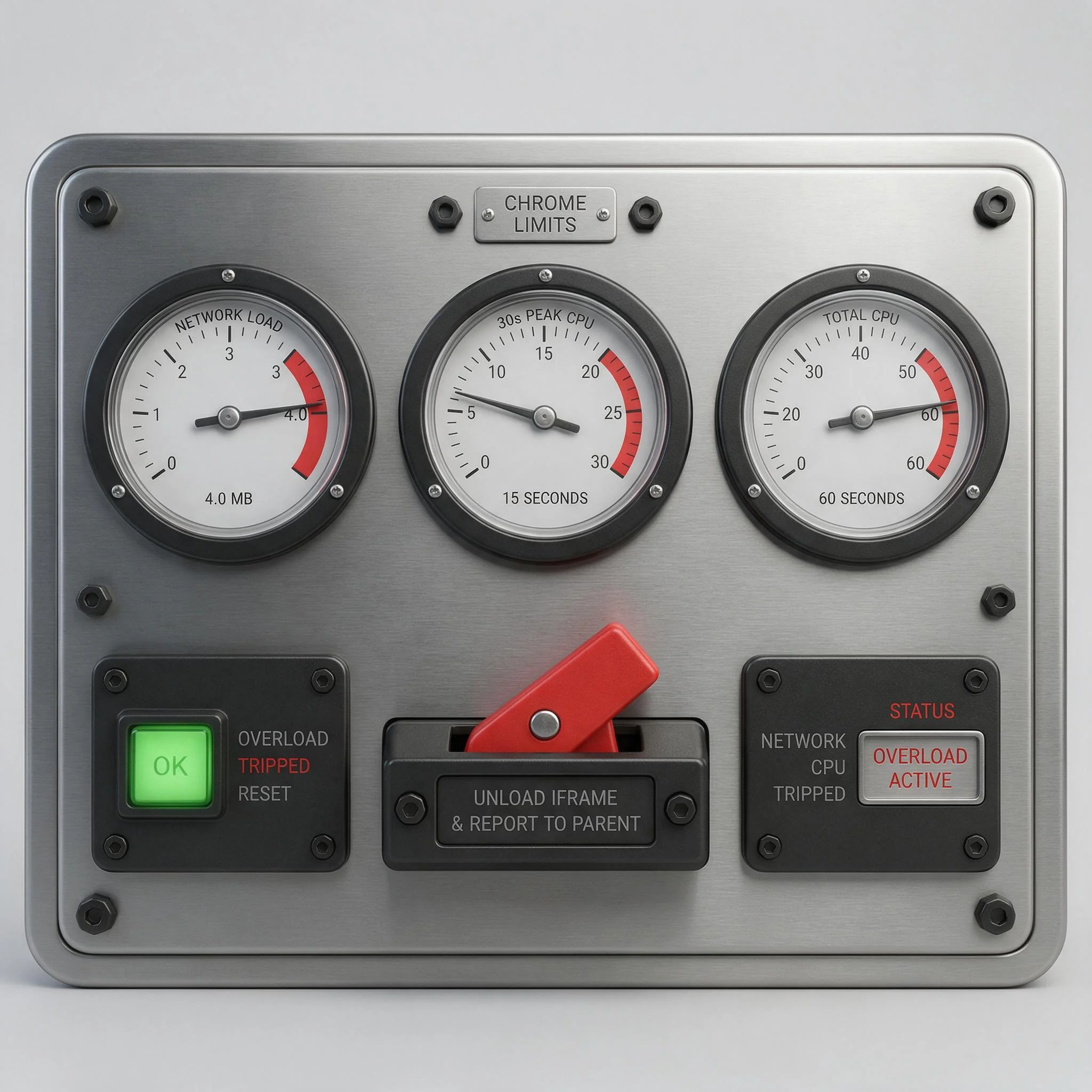
Each of these three thresholds targets a distinct failure mode in programmatic creative delivery:
- 4MB Network Bandwidth Limit: Chromium tracks the cumulative compressed bytes received over the network by all resources initiated within the ad frame tree, ignoring responses served from the HTTP cache or data URLs. To prevent malvertisers from probing the exact byte boundary to fingerprint users or game the filter, Chromium adds a small randomized fuzzing jitter to the 4MB cap on every page load. In production programmatic auctions, breaches of the 4MB threshold across standard banner formats are almost always caused by unoptimized HTML5 bundles pulling uncompressed PNG sprite sheets, custom multi-megabyte web font packages, or rogue third-party wrappers secretly loading auto-play video streams inside a
300x250display slot. - 15 Seconds Peak CPU in a 30-Second Rolling Window: This threshold halts creatives that monopolize the browser main thread or worker threads at 50% sustained capacity over half a minute. Common culprits include unthrottled
requestAnimationFrameloops rendering WebGL or HTML5<canvas>particle effects, infinite user-sync pixel loops triggered by malformed supply paths, and obfuscated JavaScript telemetry wrappers performing continuous DOM layout thrashing. - 60 Seconds Total CPU Allocation: Even if an ad creative keeps its burst CPU utilization below the 15-second peak window, Chromium tracks cumulative CPU execution time across the entire lifespan of the ad frame. On long-session publisher properties (such as live sports scoreboards, financial tickers, or multi-page infinite-scroll news layouts where ad slots are not regularly refreshed), a background animation loop consuming just 1.5 seconds of CPU per minute will hit the 60-second cumulative ceiling at the 40-minute mark and get terminated.
Crucially, Chromium suspends these thresholds the moment a user performs a direct gesture (a tap or mouse click) inside the ad iframe. However, hover events and programmatic scroll triggers do not count as user interaction. If an ad is unloaded before reaching the MRC viewability standard (50% of pixels in view for 1 continuous second for display, or 2 seconds for video), the impression registers as unviewed in GAM, eroding historical slot viewability scores and depressing clearing prices in subsequent auctions.
How Chrome Delivers Intervention Reports to the Parent Embedding Frame
Understanding why Heavy Ad Interventions previously escaped publisher detection requires inspecting how programmatic ad wrappers structure the DOM. When Google Publisher Tag (gpt.js) renders a winning line item, it injects an iframe with a deterministic identifier such as google_ads_iframe_/21700000001/desktop_leaderboard_0. When Prebid.js wins the auction, GPT loads the Prebid universal creative inside that container, which may in turn inject a friendly iframe or a third-party DSP tag that spawns additional nested cross-origin iframes (<iframe> inside <iframe>).
In early implementations of Heavy Ad Intervention, Chromium only emitted the intervention notification inside the specific child context that crossed the resource limit, or via out-of-band Report-To / Reporting-Endpoints HTTP response headers attached to the third-party ad server's document response. Because the publisher's page-level JavaScript cannot attach observers inside a cross-origin DSP iframe due to the Same-Origin Policy, the unload occurred silently from the perspective of the top-level window.
Chromium's reporting architecture upgrade solves this by propagating the intervention report upward to the parent embedding frame and appending the unloaded child frame's HTML id attribute and frame URL directly into the diagnostic message string. When GPT renders an ad inside a friendly iframe or when the root ad container itself is tagged and unloaded by the browser, the parent document receives the structured intervention payload. By reading the frame id and URL reported by Chromium, engineering teams building web publisher solutions can traverse the DOM from the reported frame back to the enclosing GPT slot div, query the active Prebid.js auction registry for that exact adUnitCode, and extract the offending bidder's creativeId, adomain, and dealId.
Using the ReportingObserver API (Baseline 2026) to Log Offending Creatives and Bidders
To capture these unloads programmatically without polling the DOM, AdOps engineers rely on the W3C ReportingObserver interface. As detailed in the ReportingObserver API documentation, the ReportingObserver API (Baseline 2026 across modern browsers) collects browser intervention and deprecation reports in real time via new ReportingObserver(callback, { types: ['intervention'], buffered: true }).
Passing buffered: true in the observer options dictionary is mandatory in production header bidding environments. Ad scripts frequently execute asynchronously before analytics bundles finish hydrating; buffering ensures that any Heavy Ad Intervention triggered during the initial page load phase is queued by the browser engine and delivered the instant the observer callback registers.
When a Heavy Ad Intervention occurs, the observer callback receives an array of Report objects. Each report where report.type === 'intervention' and report.body.id === 'HeavyAdIntervention' contains a report.body.message string indicating which threshold was breached (Network limit, Peak CPU limit, or Total CPU limit) along with the unloaded frame's identifier and URL. The following production JavaScript module demonstrates how to instantiate ReportingObserver, parse the Chromium intervention payload, correlate the unloaded frame with GPT slots and Prebid.js 11.x winning bid metadata, and transmit the diagnostic beacon to an ingestion pipeline:
(function initHeavyAdTelemetry() {
  if (typeof window.ReportingObserver === 'undefined') return;

  function classifyBreachReason(message) {
    if (!message) return 'unknown';
    if (message.includes('Network limit')) return 'network_4mb';
    if (message.includes('Peak CPU limit')) return 'cpu_peak_15s';
    if (message.includes('Total CPU limit')) return 'cpu_total_60s';
    return 'unspecified_heavy_ad';
  }

  function resolveGptAndPrebidMetadata(message, sourceUrl) {
    const attribution = {
      adUnitCode: null,
      gptLineItemId: null,
      gptCreativeId: null,
      bidderCode: null,
      prebidCreativeId: null,
      adomain: null,
      cpm: null
    };

    if (!window.googletag || !window.googletag.pubads) return attribution;

    const slots = window.googletag.pubads().getSlots();
    for (const slot of slots) {
      const slotElementId = slot.getSlotElementId();
      const responseInfo = slot.getResponseInformation();
      const iframeIdPattern = 'google_ads_iframe_' + slot.getAdUnitPath();

      if (
        (message && (message.includes(slotElementId) || message.includes(iframeIdPattern))) ||
        (sourceUrl && sourceUrl.includes(slotElementId))
      ) {
        attribution.adUnitCode = slotElementId;
        if (responseInfo) {
          attribution.gptLineItemId = responseInfo.lineItemId || null;
          attribution.gptCreativeId = responseInfo.creativeId || null;
        }
        break;
      }
    }

    if (attribution.adUnitCode && window.pbjs && typeof window.pbjs.getAllWinningBids === 'function') {
      const winningBid = window.pbjs
        .getAllWinningBids()
        .find((bid) => bid.adUnitCode === attribution.adUnitCode);

      if (winningBid) {
        attribution.bidderCode = winningBid.bidderCode || null;
        attribution.prebidCreativeId = winningBid.creativeId || null;
        attribution.adomain = Array.isArray(winningBid.meta?.advertiserDomains)
          ? winningBid.meta.advertiserDomains[0]
          : null;
        attribution.cpm = winningBid.cpm || null;
      }
    }

    return attribution;
  }

  const observer = new ReportingObserver(
    (reports) => {
      for (const report of reports) {
        if (!report.body || report.body.id !== 'HeavyAdIntervention') continue;

        const message = report.body.message || '';
        const breachReason = classifyBreachReason(message);
        const adMeta = resolveGptAndPrebidMetadata(message, report.url);

        const payload = JSON.stringify({
          eventType: 'chrome_heavy_ad_intervention',
          timestamp: Date.now(),
          pageUrl: window.location.href,
          reportUrl: report.url,
          breachReason: breachReason,
          rawMessage: message,
          attribution: adMeta
        });

        if (navigator.sendBeacon) {
          navigator.sendBeacon('https://telemetry.skyboosts.com/v1/interventions', payload);
        }
      }
    },
    { types: ['intervention'], buffered: true }
  );

  observer.observe();
})();
To ensure complete coverage when GAM renders third-party tags inside cross-origin SafeFrame containers, publishers should also attach this lightweight observer snippet as a creative template wrapper inside GAM or inject it into the Prebid universal creative rendering frame. When both the top-level document and the immediate slot iframe run ReportingObserver, no descendant ad frame unload can escape attribution.
Blocking Overweight Creatives at the SSP Level
Collecting HeavyAdIntervention beacons on the client is only half of the remediation loop; the ultimate objective is preventing non-compliant creatives from winning auctions in the first place. When a specific prebidCreativeId (crid) or adomain repeatedly triggers network_4mb or cpu_peak_15s unloads, allowing that creative to continue participating in client-side or server-side auctions wastes outbound QPS and cannibalizes high-viewability inventory.
Within our unified monetization platform, real-time intervention telemetry feeds directly into automated OpenRTB 2.6 supply enforcement rules and Prebid Server filtering middleware:
- Automated Creative Quarantine by
cridand Seat: When telemetry aggregation detects that a specificbidderCode+cridcombination exceeds a 0.5% intervention rate over 10,000 impressions, the creative ID is automatically pushed to the Prebid Server response validator blocklist. Any subsequent OpenRTBseatbid.bidobject returning thatcridis stripped before the auction response reaches the browser. - Enforcing OpenRTB 2.6 Attribute and Bandwidth Signals: Sell-side wrappers and Prebid Server endpoints should explicitly populate
imp.banner.battrin outbound OpenRTB 2.6 bid requests to block intrusive creative attributes such as6(In-Banner Video Ad - Auto-Play) and16(Provides an "Ad-Like" Experience / Heavy Rich Media) on standard display placements. Additionally, passing maximum byte constraints in SSP-to-DSP seat configurations stops buy-side bidders from trafficking un-transcoded video assets into display slots. - Pre-Flight Headless Chromium Verification: Before new direct or curated PMP deals go live, creative markup (
adm) is executed inside an isolated headless Chromium sandbox instrumented with Chrome DevTools Protocol (Performance.getMetricsandNetwork.loadingFinished). Any creative that exceeds 3.2MB of network transfer (maintaining a 20% safety buffer below Chromium's 4MB fuzzed limit) or consumes more than 8 seconds of main-thread CPU over a 30-second trace is rejected before serving a single live impression.
For publisher AdOps and engineering teams, deploying ReportingObserver with { types: ['intervention'], buffered: true } is an immediate, zero-latency upgrade to yield defense. By tying Chromium's parent-frame intervention reports directly to Prebid and GAM slot state, you eliminate silent viewability degradation, protect main-thread responsiveness, and hold every participating demand source accountable to strict browser resource budgets.