
Optimizing Ad Rendering in AMP and Modern Multi-Page Applications with the Speculation Rules API
Firing a programmatic ad auction before a browser document achieves foreground viewport activation causes three immediate monetization failures: collapsed

Firing a programmatic ad auction before a browser document achieves foreground viewport activation causes three immediate monetization failures: collapsed Active View measurability, wasted demand-side platform (DSP) queries per second (QPS), and aggressive algorithmic bid shading. When a page preloads in an invisible background tab or renders off-screen inside an Accelerated Mobile Pages (AMP) viewer, any premature execution of Prebid or Google Publisher Tag (GPT) auctions decouples the bid request timestamp from the actual human impression event. If a user abandons the navigation before viewing the document, the auction clears in memory but never fires a billable impression beacon, driving down the publisher's bid-to-impression ratio and triggering supply path optimization (SPO) throttling across tier-1 DSPs.
Publisher engineering and AdOps teams frequently manage a dual-stack architecture to achieve instantaneous page loads. Legacy mobile syndication feeds and news aggregators still rely on AMP containers, where strict runtime sandboxing prohibits arbitrary third-party JavaScript and forces header bidding through server-side Real-Time Config (RTC) callouts. Simultaneously, core web properties are migrating away from AMP toward standard HTML5 Multi-Page Applications (MPAs) accelerated by the W3C Speculation Rules API, which prerenders outgoing links in hidden background browsing contexts prior to user clicks.
Maximizing yield across both environments requires strict synchronization between document lifecycle states and auction execution. By combining server-to-server (S2S) Prebid aggregation inside AMP's constrained RTC pipeline with document.prerendering lifecycle gates in standard HTML5 architectures, publishers can capture sub-second page transitions without sacrificing bid density, viewability scores, or inventory quality.
How Real-Time Config (RTC) Communicates with Prebid Server
The AMP runtime enforces deterministic rendering performance by banning publisher-authored and third-party JavaScript from the main document thread. Because standard client-side Prebid.js wrappers cannot execute inside an AMP document, header bidding must run asynchronously through the AMP Fast Fetch rendering pipeline paired with the Real-Time Config (RTC) extension. Under the AMP monetization specification, AMP Fast Fetch Real-Time Config (RTC) allows <amp-ad> tags to make up to 5 parallel callouts to targeting and bidding endpoints (such as Prebid Server) before dispatching the primary ad request to the ad server, and supports data-loading-strategy="prefer-viewability-over-views" to align slot rendering with user scroll behavior.
When the AMP runtime parses an <amp-ad type="doubleclick"> element, Fast Fetch initiates the auction sequence well before the creative iframe is constructed. The runtime reads the child <script type="application/json" id="amp-rtc"> configuration block, resolves dynamic AMP macros (such as ATTR(data-slot), VIEWPORT_WIDTH, VIEWPORT_HEIGHT, PAGEVIEWID, and CONSENT_STRING), and dispatches parallel HTTPS GET requests to the configured RTC endpoints. When communicating with Prebid Server (Go or Java), the RTC callout passes a tag_id parameter that maps to a stored OpenRTB 2.6 impression template hosted on the server cluster.
Prebid Server looks up the stored request, injects the client's macro-populated device, consent, and viewport signals, and executes a server-side auction across participating SSP partners and curated demand sources. Every bidder adapter must respond within the timeout defined in the rtc-config block, which the AMP runtime caps at a hard maximum of 1000 milliseconds (and which AdOps teams typically tune between 500ms and 750ms). Prebid Server caches the winning bid creative payloads in Prebid Cache and returns a flat JSON dictionary containing key-value targeting pairs (hb_pb, hb_bidder, hb_size, and hb_cache_id) back to the browser. Fast Fetch then merges these targeting keys into the scp (slot-level custom parameters) query string of the outbound Google Ad Manager (GAM) gampad/ads request.
To prevent Fast Fetch from requesting and rendering ads too far down the page where users never scroll, engineers configure the data-loading-strategy attribute directly on the <amp-ad> node. By default, AMP begins fetching ads when the slot sits within 3 viewports of the current scroll position. Setting data-loading-strategy="prefer-viewability-over-views" tightens this threshold to 1.25 viewports, holding the RTC callout and GAM ad request until the user scrolls near the placement. This configuration protects high-value banner formats from rendering off-screen, raising Active View percentages and protecting domain-level floor pricing.
<amp-ad width="300" height="250"
    type="doubleclick"
    data-slot="/21800000000/mobile_article_mpu_1"
    data-loading-strategy="prefer-viewability-over-views"
    data-multi-size="300x250,300x50"
    data-multi-size-validation="false"
    rtc-config='{
      "vendors": {
        "prebidappnexus": {
          "PLACEMENT_ID": "amp_mpu_300x250_stored_req_01",
          "ACCOUNT_ID": "skyboosts_pbs_prod"
        }
      },
      "urls": [
        "https://pbs.skyboosts.com/openrtb2/amp?tag_id=amp_mpu_300x250_01&w=ATTR(width)&h=ATTR(height)&ow=ATTR(data-override-width)&oh=ATTR(data-override-height)&ms=ATTR(data-multi-size)&slot=ATTR(data-slot)&targeting=TGT&curl=CANONICAL_URL&timeout=TIMEOUT&adcid=ADCID&purl=HREF&gdpr_consent=CONSENT_STRING"
      ],
      "timeoutMillis": 650
    }'>
</amp-ad>
The 5-Call RTC Vendor Limit and Why Server-to-Server Aggregation Wins
While RTC bridges the gap between AMP's sandboxed DOM and programmatic header bidding, the protocol enforces a rigid concurrency ceiling: an <amp-ad> slot can execute a maximum of 5 parallel RTC callouts in total across both the vendors object and the custom urls array. If an AdOps team declares four named vendor macros alongside two custom JSON endpoints in rtc-config, the AMP runtime immediately truncates the sixth callout and logs a console error. Furthermore, each discrete RTC callout initiates a separate client-side HTTPS request from the user's mobile device, adding DNS lookup latency, TLS handshake overhead, and cellular radio contention during critical page hydration.
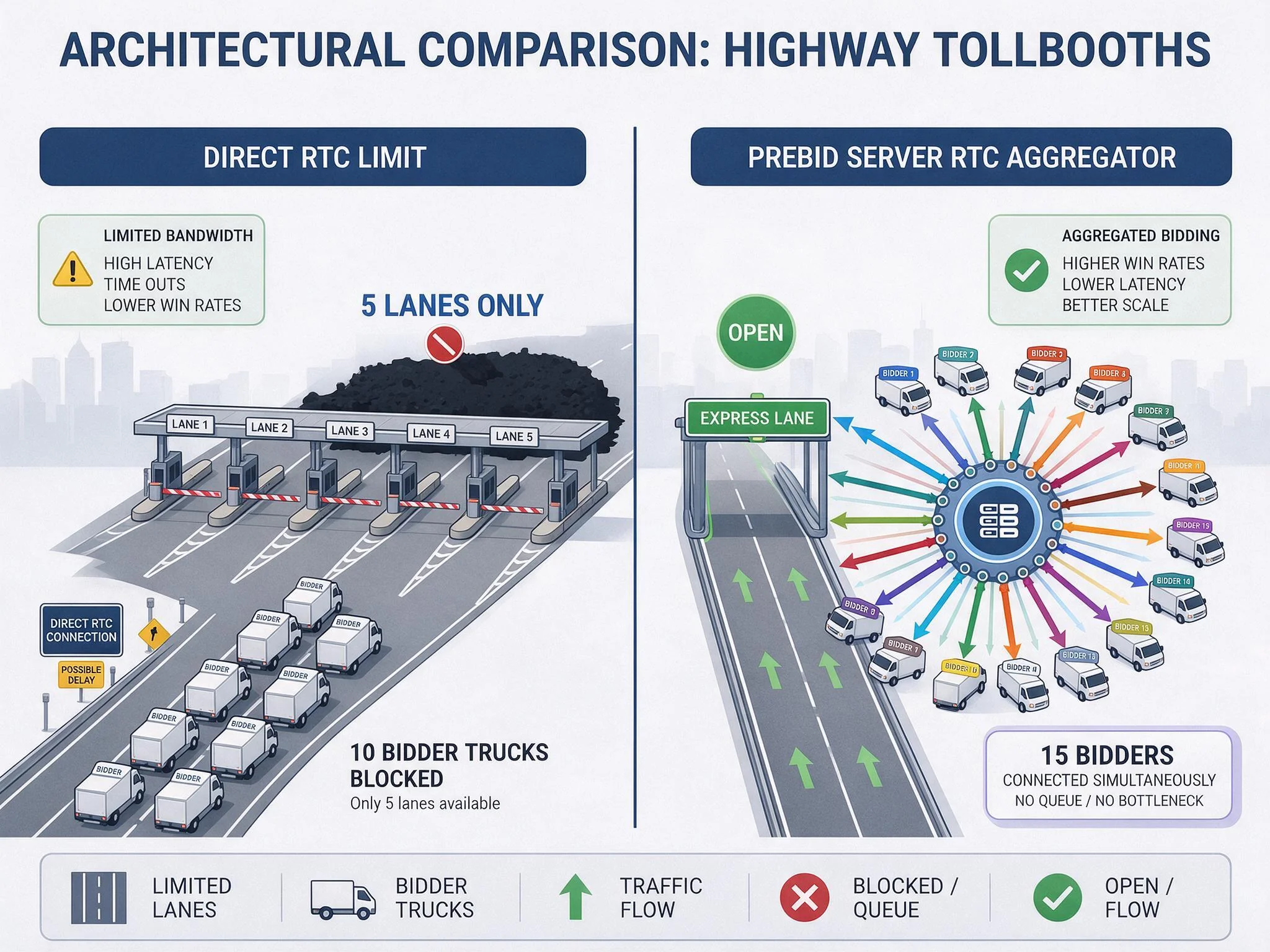
Allocating those five client-side RTC slots to individual, single-SSP endpoints creates an artificial bid density bottleneck. In a first-price GAM auction, clearing prices scale directly with the number of unique demand sources competing simultaneously for the impression. Restricting an <amp-ad> placement to five direct SSP callouts leaves zero room for real-time data (RTD) identity resolvers, contextual classification endpoints, or first-party DMP targeting lookups, while starving the auction of competitive bid pressure.
Routing a single custom URL callout in rtc-config to a unified Prebid Server cluster removes this ceiling entirely. When the <amp-ad> element dispatches one request to our edge-deployed Prebid Server infrastructure, that single browser callout fans out server-side to 15 or more participating SSP partners and tier-1 DSPs over persistent, warm HTTP/2 connections with sub-10ms data-center round-trip times. Simultaneously, inside GAM 360, Google Open Bidding and AdX compete in parallel against the aggregated Prebid Server key-values returned by RTC. This architecture delivers latency-optimized ad delivery while reserving the remaining four client-side RTC slots for contextual brand-safety wrappers or first-party audience segments. At Sky Boosts, all server-side RTC demand is strictly filtered for 100% Google-friendly, mainstream brand-safe creatives (excluding alcohol, gambling, adult, and tobacco categories) and verified through HUMAN and Pixalate invalid traffic (IVT) pre-bid screening, backed by predictable Net-30 and Net-60 publisher payment terms.
Beyond AMP: Instant Page Transitions in Standard HTML5 Using the Speculation Rules API
With search engines evaluating page experience through Core Web Vitals (Largest Contentful Paint, Interaction to Next Paint, and Cumulative Layout Shift) rather than requiring AMP markup, engineering teams are consolidating traffic back onto standard HTML5 Multi-Page Applications. Standard HTML5 restores full access to client-side Prebid.js 11.x modules, dynamic price floor engines, user ID submodules, and high-impact video and native placements. To match the instant loading speed previously provided by pre-warmed AMP caches, modern Chromium browsers implement the Speculation Rules API, which uses a declarative <script type="speculationrules"> JSON block to prefetch or prerender outgoing HTML navigations in an invisible background tab.
The API supports two distinct speculative mechanics: prefetch and prerender. While prefetch downloads only the top-level HTML document bytes into the browser's memory cache without parsing subresources or executing JavaScript, prerender constructs a fully isolated, hidden rendering context. During a prerender operation, the browser downloads the target HTML, fetches CSS and JavaScript bundles, constructs the DOM, and executes main-thread scripts in the background before the user clicks the anchor link. When the click occurs, the browser swaps the hidden tab into the foreground viewport instantaneously, producing a near-zero Largest Contentful Paint (LCP).
<script type="speculationrules">
{
  "prerender": [
    {
      "where": {
        "and": [
          { "href_matches": "/articles/*" },
          { "not": { "href_matches": "/articles/preview/*" } },
          { "not": { "selector_matches": "[rel~=nofollow]" } }
        ]
      },
      "eagerness": "moderate"
    }
  ]
}
</script>
Safely Deferring GPT and Prebid Auctions During Prerendering (document.prerendering and prerenderingchange)
Deploying "prerender" rules on an ad-supported site without modifying the ad-tech initialization lifecycle causes severe auction synchronization failures. To protect browser memory and prevent background audio or premature pixel firing, the browser runtime enforces automatic guards during prerendering: cross-origin iframes (including Google Publisher Tag SafeFrame creative containers) have their network loading and rendering automatically deferred until the user activates the page. However, first-party and third-party JavaScript tags embedded directly in the parent HTML document, including gpt.js and prebid.js, execute immediately while the page is still hidden in the background.
If Prebid.js 11.x and GPT run unguarded inside a prerendered document, three production problems occur:
- Unfilled QPS and Bid Shading Penalties: When
eagernessis set to"moderate"(which triggers prerendering when a user hovers a cursor over a link for 200ms or initiates apointerdownevent), roughly 35% to 55% of prerendered pages are never clicked. Ifpbjs.requestBids()fires during prerendering, SSPs and DSPs receive real OpenRTB 2.6 bid requests for pages that are subsequently discarded. High volumes of won auctions that never fire billable impression beacons degrade a publisher's render rate metrics, prompting DSP algorithms to apply aggressive bid shading or QPS throttling. - Bid Cache Expiration and Auction Desynchronization: Even when the user eventually clicks the prerendered link, several seconds may elapse between the background auction and tab activation. Prebid bid responses sitting idle in memory risk exceeding their time-to-live (TTL) window or missing GAM's impression billing tolerances once the deferred cross-origin ad iframes finally mount.
- IVT False Positives: Firing auction telemetry or custom verification scripts while
document.visibilityStateis hidden anddocument.prerenderingistruecan trigger anomalous non-human traffic heuristics in post-bid IVT scanners.
To engineer around this, the Speculation Rules API exposes the boolean property document.prerendering and the prerenderingchange event on the Document interface. The optimal AdOps architecture splits initialization into two distinct phases. During the background prerender phase (document.prerendering === true), the browser should download and parse the gpt.js and prebid.js libraries, define the GPT ad slots, and register Prebid ad units and consent configurations so the CPU work is complete. However, the actual network auction calls (pbjs.requestBids() and googletag.pubads().refresh()) must be gated behind a prerenderingchange event listener so they fire at the exact millisecond the user activates the tab.
window.googletag = window.googletag || { cmd: [] };
window.pbjs = window.pbjs || { que: [] };

const PREBID_TIMEOUT = 1000;

// Phase 1: Safe to execute during background prerendering (CPU & config setup)
function initializeAdStackConfig() {
  googletag.cmd.push(function () {
    googletag.pubads().disableInitialLoad();
    googletag.defineSlot('/21800000000/web_leaderboard_top', [[728, 90], [970, 250]], 'div-gpt-ad-top')
      .addService(googletag.pubads());
    googletag.pubads().enableSingleRequest();
    googletag.enableServices();
  });

  pbjs.que.push(function () {
    pbjs.setConfig({
      priceGranularity: 'high',
      enableTIDs: true,
      userSync: {
        filterSettings: { iframe: { bidders: '*', filter: 'include' } }
      }
    });

    pbjs.addAdUnits([
      {
        code: 'div-gpt-ad-top',
        mediaTypes: {
          banner: { sizes: [[728, 90], [970, 250]] }
        },
        bids: [
          {
            bidder: 'skyboosts',
            params: { placementId: 'sb_web_top_728x90', publisherId: 'pub_99412' }
          }
        ]
      }
    ]);
  });
}

// Phase 2: Network auction execution (MUST wait for foreground activation)
function executeProgrammaticAuction() {
  pbjs.que.push(function () {
    pbjs.requestBids({
      timeout: PREBID_TIMEOUT,
      bidsBackHandler: function () {
        pbjs.setTargetingForGPTAsync();
        googletag.cmd.push(function () {
          googletag.pubads().refresh();
        });
      }
    });
  });
}

// Lifecycle Gate: Check Speculation Rules prerendering state
initializeAdStackConfig();

if (document.prerendering) {
  document.addEventListener('prerenderingchange', function () {
    executeProgrammaticAuction();
  }, { once: true });
} else {
  executeProgrammaticAuction();
}
By pre-loading the JavaScript bundles and configuring slot state during the background prerender while holding pbjs.requestBids() and googletag.pubads().refresh() until prerenderingchange fires, publishers eliminate ~150ms to 300ms of script evaluation latency from the critical path without generating phantom QPS. Whether monetizing <amp-ad> tags through single-call Prebid Server RTC aggregation or accelerating HTML5 MPAs with the Speculation Rules API, gating auction network calls to verified viewport activation ensures every bid request translates into a measurable, high-viewability impression.