
Understanding Bid Shading and Clearing Price Mechanics in First-Price Programmatic Auctions
In an OpenRTB 2.6 bid request, setting the root-level integer at: 1 instructs every downstream demand-side platform (DSP) that the auction will clear at the

In an OpenRTB 2.6 bid request, setting the root-level integer at: 1 instructs every downstream demand-side platform (DSP) that the auction will clear at the exact price submitted by the highest valid bidder. That single specification field shifts the mathematical burden of price discovery away from the supply-side exchange engine and directly onto the buyer's machine-learning inference pipeline. Under legacy second-price mechanics (at: 2), a buyer could safely submit an advertiser's true intrinsic valuation of $12.00 CPM knowing that if the next-highest competing bid sat at $4.50 CPM, the impression would clear at $4.51. Under unified first-price rules, submitting that same unadjusted $12.00 bid forfeits $7.49 per thousand impressions in immediate buyer surplus.
To prevent systematic overpayment, tier-1 DSPs deploy real-time bid shading algorithms that sit between the campaign valuation engine and the outbound OpenRTB serializer. These models evaluate historical clearing distributions, supply path metadata, and competing bid density within a 10-millisecond computational window to discount the outbound bid toward the estimated minimum price required to win the impression. When a DSP's shading algorithm accurately predicts a sparse auction and discounts a $12.00 valuation down to $4.60, the buyer captures the impression while retaining nearly all economic surplus.
For publisher yield engineers and AdOps architects, bid shading transforms floor management and header bidding orchestration from passive price thresholding into an active statistical contest. Maintaining true market value across Web, Mobile App, and Connected TV (CTV) inventory requires engineering telemetry into our first-price auction infrastructure so that floor elasticity, wrapper timeout curves, and bid density actively prevent buy-side algorithms from depressing clearing prices toward artificial baselines.
The Industry Shift from Second-Price to Unified First-Price Auctions
The programmatic ecosystem abandoned second-price Vickrey auctions because multi-tiered header bidding broke the theoretical incentive compatibility of second-price mechanics. In a pure academic Vickrey auction, a single auctioneer collects sealed bids simultaneously and charges the winner one cent above the runner-up, making truthful bidding the dominant strategy. Once publishers deployed client-side Prebid.js wrappers and server-to-server connections ahead of the primary ad server, the auction fragmented into a two-stage cascade: participating SSP partners conducted isolated internal auctions first, and their winning bids then entered the publisher's ad server to compete against direct line items and exchange demand.
When an SSP executed an internal second-price auction during that first stage, it created severe clearing distortions. Suppose Bidder A submitted $9.00 and Bidder B submitted $3.00 inside a single SSP. A second-price reduction dropped Bidder A's clearing price to $3.01 before passing that value via key-value targeting (hb_pb) into the ad server. Inside the ad server, that $3.01 bid could easily lose to a $4.50 bid from a competing SSP or an ad server dynamic allocation call, even though Bidder A was willing to pay up to $9.00. Worse, non-transparent supply paths exploited second-price mechanics by inserting artificial dynamic floors between the first and second highest bids after inspecting the incoming bid array, effectively turning declared second-price auctions into undeclared first-price captures.
Google Ad Manager (GAM 360) resolved this structural distortion in 2019 by transitioning AdX, Open Bidding, and non-guaranteed remnant line items into a Unified First-Price Auction. Under this architecture, Prebid header bidding responses, Open Bidding partners, AdX buyers, and non-guaranteed direct tags compete simultaneously in a single flat auction where the highest net bid wins and pays its exact submitted price. Guaranteed sponsorship and standard line items remain excluded from price competition to satisfy contracted impression goals, though their programmatic equivalents can participate via Programmatic Guaranteed protocols.
{
  "id": "80ce30c53c16e",
  "at": 1,
  "tmax": 120,
  "imp": [
    {
      "id": "1",
      "banner": { "w": 300, "h": 250 },
      "bidfloor": 2.40,
      "bidfloorcur": "USD"
    }
  ],
  "ext": {
    "prebid": { "channel": { "name": "pbjs", "version": "11.2.0" } }
  }
}
In this standardized OpenRTB 2.6 payload, the SSP explicitly signals at: 1 alongside a hard floor of 2.40 USD. Because there is no secondary reduction layer inside the exchange or inside GAM 360, every DSP receiving this request must compute its own optimal discount prior to returning the bid response.
How DSP Bid Shading Algorithms Estimate the Minimum Winning Price
A DSP bid shading engine solves a constrained optimization problem on every incoming bid request: maximize the expected buyer surplus given an advertiser's intrinsic valuation $V$ and the probability of winning the auction at a shaded bid price $b$. Mathematically, the DSP seeks to find the bid $b \in [F, V]$ (where $F$ is the declared imp.bidfloor) that maximizes the objective function $(V - b) \cdot P(\text{win} \mid b, X)$, where $X$ represents the vector of contextual and user features extracted from the OpenRTB request. Taking the derivative with respect to $b$ shows that the optimal shaded bid balances the marginal increase in win probability against the marginal forfeiture of price discount.
To construct the win-probability cumulative distribution function $P(\text{win} \mid b, X)$, tier-1 DSPs train survival analysis models and gradient-boosted decision trees on petabytes of historical auction outcomes. A fundamental challenge in training these models is right-censored data: when a DSP wins an impression in a strictly closed first-price auction, it learns that the competing market price was somewhere below $b$, and when it loses without feedback, it only knows the clearing price exceeded $b$. To overcome censorship, DSPs rely on OpenRTB loss notification URLs (lurl) populated with the ${AUCTION_MIN_TO_WIN} macro, post-auction clearing range signals, and deliberate exploration traffic where the DSP submits unshaded bids on 1% to 3% of requests to map the true upper tail of the publisher's clearing distribution.
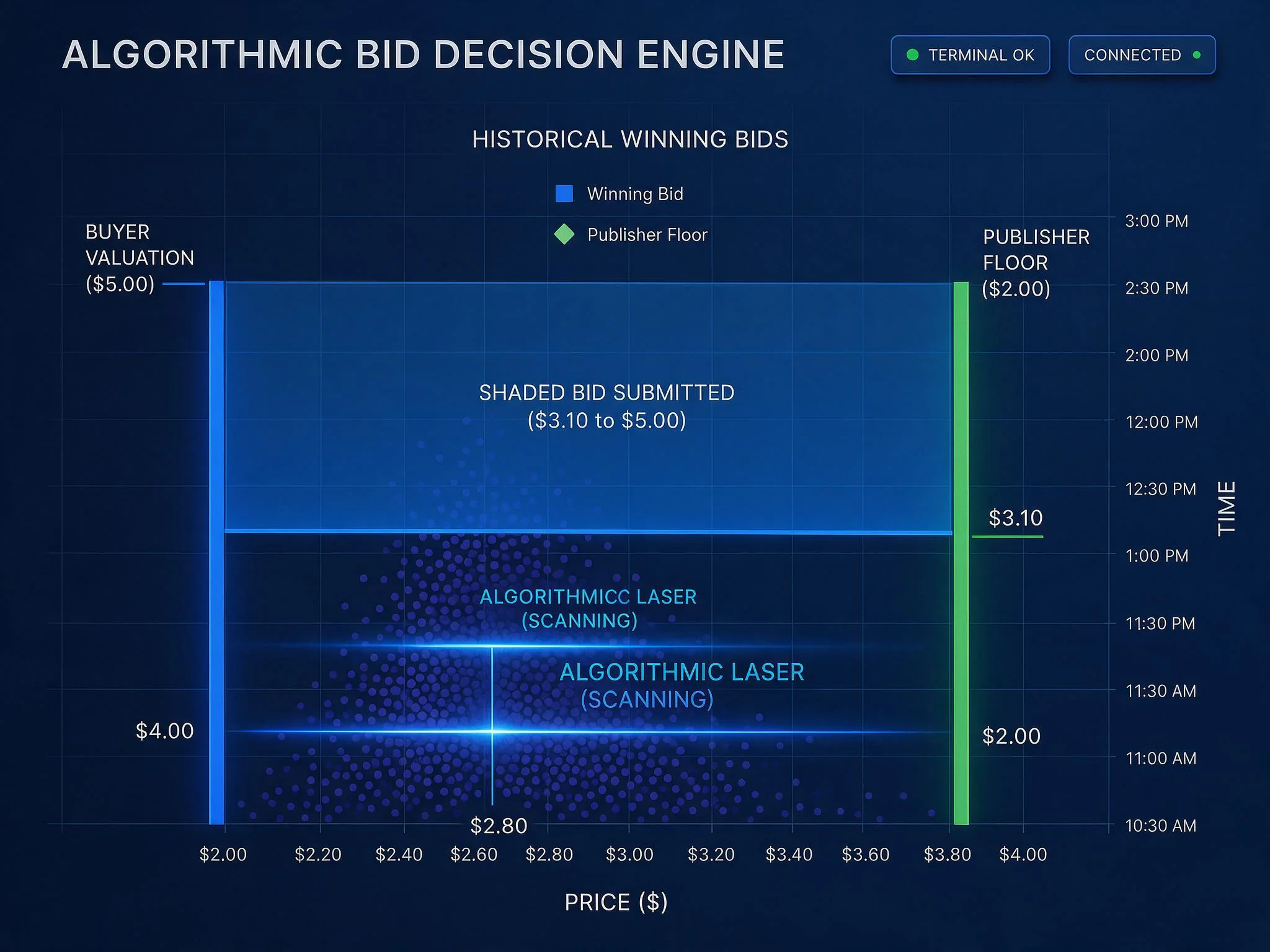
The steepness of the DSP's survival curve depends heavily on bid density and identity resolution across the specific inventory cohort. When an impression originates from an unauthenticated mobile web browser with only two active bidders and no universal ID sub-modules, the historical clearing distribution exhibits high variance and a low median. The shading algorithm detects this sparse competition and applies an aggressive discount factor, often shaving 45% to 65% off the original valuation $V$. Conversely, when our unified SSP and monetization platform packages verified, 100% Google-friendly and HUMAN / Pixalate IVT-clean inventory enriched with first-party publisher signals and high-density CTV or in-app demand, the clearing distribution compresses into a tight band just below $V$. Under high bid density, any substantial shading discount causes the DSP's win probability $P(\text{win} \mid b, X)$ to plummet toward zero, forcing the model to submit a bid closely aligned with true advertiser value. Publishers tracking these cross-channel compression dynamics can compare regional clearing spreads in our quarterly eCPM benchmarks.
How Publisher Floor Volatility (and Prebid skipRate Sampling) Defeats Aggressive Bid Shading
When a publisher deploys static, predictable price floors across an ad unit, those floors inadvertently act as training beacons for buy-side shading algorithms. Suppose an AdOps team configures a fixed $3.00 CPM floor in GAM Unified Pricing Rules (UPRs) and Prebid for a high-viewability desktop leaderboard. Within hours, DSP survival models observe a sharp discontinuity in win rate: 0% of bids below $3.00 win, while bids at $3.02 achieve high win rates whenever competing demand is quiet. For every auction where a DSP's intrinsic valuation is $8.00 and competing bids are below $3.00, the static floor teaches the DSP to cluster its shaded bids at $3.01 to $3.05, capturing nearly $5.00 in surplus while giving the publisher the illusion that the floor is performing efficiently.
Defeating this convergence requires two mechanisms: empirical measurement of how shading models behave in the absence of floors, and controlled stochastic floor volatility across auction cohorts. The Prebid Price Floors module uses a configurable skipRate integer (0-100) and Schema 2 modelWeight sampling to hold back floors on a slice of auctions, allowing publishers to measure how DSP bid shading algorithms react when floors are present vs. absent. When skipRate is set to 10, Prebid suppresses the imp.bidfloor parameter on 10% of auctions and flags the analytics payload with skipped: true, establishing a clean holdout control group.
pbjs.setConfig({
  floors: {
    enforcement: { enforceJS: true, floorDeals: false },
    skipRate: 10,
    data: {
      currency: 'USD',
      schema: { fields: ['mediaType', 'size', 'domain'] },
      models: [
        {
          modelVersion: 'conservative-baseline',
          modelWeight: 30,
          values: { 'banner|300x250|skyboosts.com': 1.80, '*|*|*': 0.90 }
        },
        {
          modelVersion: 'elastic-high-pressure',
          modelWeight: 70,
          values: { 'banner|300x250|skyboosts.com': 2.65, '*|*|*': 1.35 }
        }
      ]
    }
  }
});
By pairing skipRate holdouts with multi-model modelWeight splits in Prebid.js 11.x (or synced via Prebid Server floors endpoints), yield engineers accomplish two objectives simultaneously. First, comparing the clearing CPM and fill rate of the 10% skipped cohort against the 90% floored cohort reveals whether DSPs are shading down to near-zero when floors disappear, or if organic bid density is already supporting the clearing price naturally. Second, rotating between the conservative-baseline (30% weight) and elastic-high-pressure (70% weight) schemas prevents the DSP's survival model from locking onto a single deterministic truncation point. When the minimum winning price shifts unpredictably across identical request vectors $X$, the DSP's variance estimator widens. To prevent under-delivery on pacing-sensitive advertiser budgets, the shading algorithm must reduce its discount factor and bid closer to $V$.
Publishers must balance this floor volatility against DSP QPS throttling thresholds. If an aggressive floor model drives a DSP's win rate below its internal computational efficiency threshold (often 0.5% to 2% depending on media type), the DSP's traffic-shaping router will deprioritize or throttle QPS to that supply path. Optimal floor governance therefore targets the inflection point on the revenue-per-mille (RPM) curve where marginal clearing price gains from anti-shading pressure equal the marginal revenue lost from throttled or rejected bids.
Analyzing the Gap Between Gross Bid and Net Clearing Price
Even after a DSP's bid shading algorithm computes an outbound bid, the figure emitted in seatbid.bid.price is rarely the exact net revenue credited to the publisher's ledger. Understanding the mathematical spread between the advertiser's gross spend, the DSP's shaded gross bid, and the publisher's final net clearing price is mandatory for accurate header bidding configuration and reconciliation.
Consider a transaction where an advertiser values a CTV pod impression at $25.00 CPM. The DSP's shading algorithm estimates that $18.00 CPM is sufficient to clear the auction, saving $7.00 in gross margin. Several tier-1 DSPs monetize their bid shading algorithms as a value-added product, retaining 10% to 25% of the "savings" ($0.70 to $1.75 in this scenario) before transmitting the $18.00 gross bid to the SSP. When that $18.00 OpenRTB response reaches the supply side, the SSP must either deduct its contracted revenue share server-side and emit a net bid, or pass the gross $18.00 bid into the client wrapper and rely on the publisher's Prebid configuration to adjust the bid to net before GAM 360 line-item matching occurs.
If a publisher connects multiple SSP adapters in Prebid.js 11.x without auditing whether each bidder responds in gross or net terms, the unified first-price auction breaks down inside the browser. A bidder returning a gross $10.00 CPM with a 20% take rate actually delivers $8.00 net to the publisher. If that gross $10.00 bid is mapped directly to the hb_pb: 10.00 key-value without normalization, it will defeat a competing partner submitting a true net bid of $9.20, resulting in a $1.20 CPM net yield loss on every impression won by the unadjusted adapter. AdOps teams regularly uncover these discrepancies when reconciling GAM 360 impression delivery against SSP payout reports.
To enforce true net competition in Prebid.js 11.x, engineering teams must normalize every gross-bidding adapter inside bidderSettings before price bucket quantization occurs:
pbjs.bidderSettings = {
  standard: {
    adserverTargeting: [
      { key: 'hb_pb', val: function(bidResponse) { return bidResponse.pbCg; } },
      { key: 'hb_bidder', val: function(bidResponse) { return bidResponse.bidderCode; } }
    ]
  },
  curatedSspPartner: {
    bidCpmAdjustment: function(bidCpm, bid) {
      // Normalize a gross bid with a 15% rev-share to true net USD
      return Math.round((bidCpm * 0.85) * 100) / 100;
    }
  }
};
At Sky Boosts, we architect our OpenRTB 2.6 exchange pipes, Prebid adapters, and GAM MCM configurations to eliminate hidden shading taxes and gross-to-net discrepancies across Web, Mobile App, and CTV. By enforcing transparent net clearing signals, curating high-density mainstream brand-safe demand, and backing every impression with reliable Net-30 and Net-60 payment terms, we ensure that publisher auctions clear at true market value. As an immediate engineering action item, audit your Prebid floors configuration this week: enable a 5% to 10% skipRate, verify that every active bidder is normalized to net inside bidCpmAdjustment, and measure the exact CPM delta between floored and unfloored cohorts to quantify how aggressively buy-side shading algorithms are discounting your inventory.