
Solving Audio Normalization and Loudness Jumps in CTV Ad Breaks (ATSC A/85 & EBU R128 v5 Compliance)
When a Server-Side Ad Insertion (SSAI) stitcher splices an unnormalized promotional spot mixed at -11 LUFS directly after an episodic Connected TV (CTV)

When a Server-Side Ad Insertion (SSAI) stitcher splices an unnormalized promotional spot mixed at -11 LUFS directly after an episodic Connected TV (CTV) drama segment mastered at -24 LKFS, the resulting +13 LU acoustic spike forces immediate viewer intervention. Across living-room hardware such as Roku, Apple tvOS, Amazon Fire TV, Samsung Tizen, and LG webOS, an abrupt jump in perceived volume at the #EXT-X-DISCONTINUITY boundary is one of the primary technical drivers of ad-break muting, application closure, and session abandonment. Unlike codec mismatches or bitrate starvation, which manifest as visual buffering or macroblocking, loudness jumps turn a properly stitched video stream into a jarring user experience.
The root cause of this acoustic disparity lies in the collision between theatrical or broadcast content mastering and digital social-video ad production. Episodic streaming content and linear Free Ad-Supported Streaming TV (FAST) channels are mixed with wide dynamic range to preserve dialogue clarity and cinematic headroom. Conversely, programmatic video creatives often originate from web or mobile campaigns where audio engineers apply aggressive multi-band compression and brickwall limiting to maximize perceived loudness on small smartphone speakers.
Eliminating these loudness jumps requires enforcing international broadcast loudness standards inside the programmatic supply chain. By combining automated VAST 4.3 mezzanine transcoding, ITU-R BS.1770 gated loudness measurement, and strict creative quality assurance (QA) policies at the Supply-Side Platform (SSP) boundary, publishers and streaming engineers can guarantee acoustic continuity across every stitched ad pod.
The Regulatory Landscape: The FCC CALM Act and Viewer Abandonment
In the United States, commercial loudness is governed by federal statute rather than voluntary industry convention. Under the FCC CALM Act compliance rules, television broadcasters and Multichannel Video Programming Distributors (MVPDs) are legally required to adhere to the ATSC A/85 Recommended Practice, which measures integrated loudness via the ITU-R BS.1770 algorithm at a target of -24 LKFS so that commercials match the average loudness of the programming they accompany. While the original 2010 legislation targeted linear QAM cable, satellite, and over-the-air terrestrial broadcast, regulatory scrutiny and viewer expectations have rapidly converged onto vMVPDs, FAST channels, and AVOD streaming environments.
For CTV publishers, the economic cost of non-compliant audio frequently exceeds the regulatory risk. Internal telemetry across high-volume SSAI deployments reveals a direct correlation between positive loudness deltas (ad breaks exceeding program loudness by more than 4 LU) and mid-pod stream termination. When a viewer reaches for the remote control during the first slot of a four-pod commercial break, two destructive monetization outcomes occur:
- Immediate Mute Events and Attention Decay: Hardware-level mute signals tracked via client-side player telemetry (such as Google IMA/PAL SDK or Roku RAF callbacks) surge within the first 2.5 seconds of an unnormalized ad creative. Once muted, the household rarely unmutes until the program resumes, degrading advertiser brand impact for every subsequent slot in the pod.
- Pod Abandonment and Quartile Drop-Off: On smart TV operating systems where the "Back" or "Exit" button is thumb-adjacent to the volume rocker, acoustic shock triggers complete session exits. A 5% drop in Video Completion Rate (VCR) across a multi-slot pod translates directly into lost fourth-quartile events, depressed buyer clearing prices, and algorithmic bid shading from tier-1 DSPs optimizing for completed views.
Operating a premium CTV monetization platform requires treating audio compliance with the same rigor applied to invalid traffic (IVT) filtering and brand safety. Just as publishers block malware or restricted ad categories, high-yield CTV supply paths must insulate viewers from uncalibrated audio tracks before a creative ever enters an HLS or MPEG-DASH manifest.
Understanding LUFS/LKFS (Loudness Units Full Scale) vs. True Peak Normalization
A persistent failure mode in digital video ad servers is the confusion between legacy sample peak normalization (measured in dBFS, or decibels relative to full scale) and perceived loudness normalization (measured in LKFS or LUFS). Sample peak meters only detect the single highest digital sample amplitude within an audio file. A quiet drama dialog scene containing a single transient door slam peaking at -1.0 dBFS registers the exact same peak value as a heavily compressed 30-second retail commercial where every millisecond of audio is pushed against a -1.0 dBFS limiter ceiling. To the human ear, the compressed commercial sounds more than twice as loud because perceived volume is dictated by sustained acoustic energy over time, not instantaneous sample peaks.
To quantify human loudness perception mathematically, the International Telecommunication Union developed the ITU-R BS.1770 specification, which forms the computational foundation for both North American ATSC A/85 (which uses the term LKFS, or Loudness, K-weighted, relative to Full Scale) and European EBU R128 (which uses LUFS, or Loudness Units relative to Full Scale). One LKFS is functionally identical to one LUFS, and one Loudness Unit (LU) equals 1 dB of change on a relative scale. The algorithm processes multichannel audio through a two-stage acoustic filter before integrating energy over gated 400-millisecond blocks:
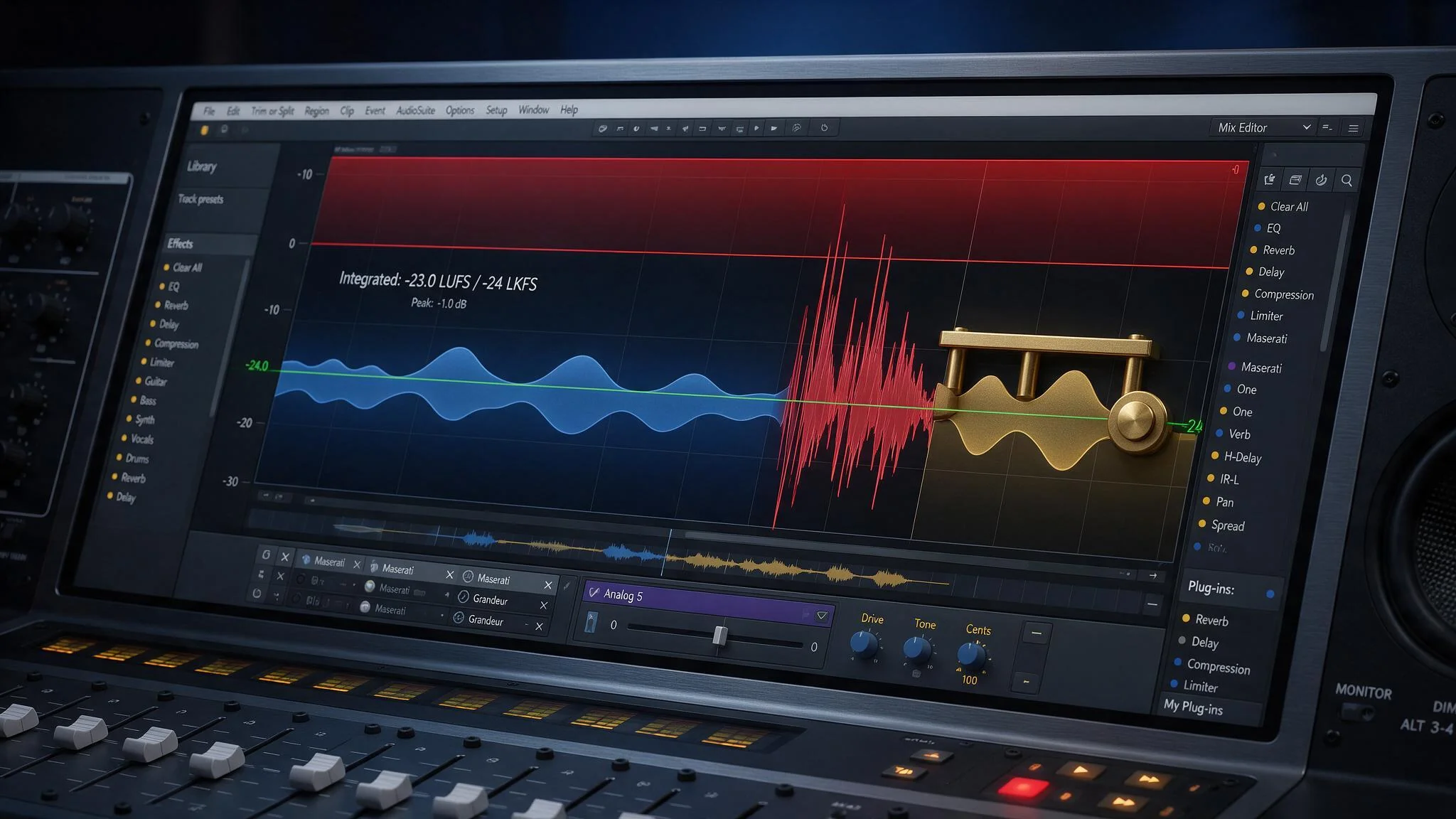
- Stage 1 (High-Shelf Pre-Filter): Models the acoustic impedance of the human head by applying a +4 dB high-shelf boost above 1.5 kHz, accounting for the human ear's heightened sensitivity to mid-high frequencies where vocal sibilance and commercial announcer voices reside.
- Stage 2 (RLB High-Pass Filter): Attenuates sub-bass frequencies below 38 Hz that carry high electrical amplitude in the waveform but contribute minimal perceived loudness in typical living-room soundbars or television speakers.
- Gated Loudness Integration: To prevent silent passages from artificially dragging down the average loudness measurement of a file, ITU-R BS.1770-4 applies an absolute silence gate at -70 LUFS and a relative gate at -10 LU below the ungated integrated average.
Alongside integrated loudness, modern CTV transcoding pipelines must enforce True Peak limits measured in dBTP (decibels True Peak). Standard digital-to-analog converters (DACs) inside television sets reconstruct continuous analog waveforms from discrete 48 kHz PCM samples. Even if individual digital samples stay below 0.0 dBFS, the reconstructed analog curve between consecutive samples can overshoot 0.0 dB, causing inter-sample clipping and harmonic distortion during AAC or Dolby transcoding. True Peak meters oversample the digital audio signal by at least 4x (192 kHz) to detect and constrain these inter-sample peaks before encoding.
EBU R128 v5 (-23.0 LUFS Target, -1 dBTP Max True Peak) and Supplement 1/2 for Adverts & Streaming
While ATSC A/85 anchors North American broadcast at -24.0 LKFS (+/- 2.0 LU tolerance), international and pan-European CTV workflows rely on the stricter EBU R128 v5 specification published in November 2023, which mandates a Programme Loudness Target Level of -23.0 LUFS (+/- 0.2 LU tolerance in file-based QC workflows, and +/- 1.0 LU for live programmes) alongside a Maximum True Peak Level of -1 dBTP. For lossy distribution codecs common in OTT streaming, EBU guidelines further recommend restricting True Peak to -2 dBTP to absorb psychoacoustic coder reconstruction overshoots.
Critically for programmatic ad operations, the European Broadcasting Union maintains two dedicated supplements cited directly within the v5 framework: EBU R128 s1 (Loudness Parameters for Short-Form Content / Adverts) and EBU R128 s2 (Loudness in Streaming). In 15-second or 30-second commercials, audio mixers historically exploited integrated loudness meters by inserting five seconds of near-silence at the end of an ad so the remaining ten seconds could play at an ear-splitting -17 LUFS while still averaging -23.0 LUFS across the whole file. EBU R128 s1 closes this loophole by enforcing a Maximum Short-Term Loudness ceiling (measured over a sliding 3-second window) of -18.0 LUFS (+5 LU above the -23.0 LUFS target). EBU R128 s2 governs how OTT platforms handle loudness metadata and normalization across heterogeneous client playback devices without crushing cinematic dynamic range.
Automated Mezzanine Ingestion and Audio Transcoding Pipelines
Because SSPs and SSAI providers cannot rely on thousands of disparate agencies and DSPs to pre-master every creative to ATSC A/85 or EBU R128 v5 tolerances, audio normalization must be enforced deterministically during creative ingestion and transcoding. When a DSP returns a VAST 4.3 response containing a high-bitrate <Mezzanine> file, our ingestion pipeline downloads the source mezzanine asset, performs an automated audio inspection, and generates normalized HLS/DASH renditions before the ad is eligible for live stream stitching across CTV video ad formats.
Relying on single-pass dynamic loudness filters in production is an anti-pattern: real-time dynamic normalization alters the internal dynamics of the commercial, causing audible gain "pumping" when background music ducks under voiceovers. Instead, institutional transcoding pipelines execute a two-pass linear normalization workflow using the loudnorm / ebur128 filter architecture. Pass 1 scans the entire mezzanine audio stream to extract the exact integrated loudness (input_i), true peak (input_tp), loudness range (input_lra), and gating threshold (input_thresh). Pass 2 feeds those measured parameters back into the transcoder so the audio can be scaled linearly by a fixed gain offset, engaging the True Peak limiter only when necessary to protect the -1.0 dBTP ceiling:
#!/usr/bin/env bash
# Two-pass EBU R128 v5 / ATSC A/85 Mezzanine Audio Normalization Pipeline
INPUT_MEZZ="creative_mezzanine_source.mp4"
OUTPUT_RENDITION="creative_normalized_1080p.mp4"
TARGET_LUFS="-24.0" # Set -24.0 for ATSC A/85 (US) or -23.0 for EBU R128 v5 (EU)
MAX_TRUE_PEAK="-1.0"
TARGET_LRA="7.0"

# Pass 1: Measure integrated loudness, true peak, and LRA across the source file
STATS_JSON=$(ffmpeg -hide_banner -nostats -i "$INPUT_MEZZ" \
  -af "loudnorm=I=${TARGET_LUFS}:TP=${MAX_TRUE_PEAK}:LRA=${TARGET_LRA}:print_format=json" \
  -f null - 2>&1 | awk '/^{/,/^}/')

MEASURED_I=$(echo "$STATS_JSON" | jq -r '.input_i')
MEASURED_TP=$(echo "$STATS_JSON" | jq -r '.input_tp')
MEASURED_LRA=$(echo "$STATS_JSON" | jq -r '.input_lra')
MEASURED_THRESH=$(echo "$STATS_JSON" | jq -r '.input_thresh')
TARGET_OFFSET=$(echo "$STATS_JSON" | jq -r '.target_offset')

# Pass 2: Apply linear loudness normalization with 4x oversampled True Peak limiting
ffmpeg -hide_banner -y -i "$INPUT_MEZZ" \
  -c:v copy \
  -af "loudnorm=I=${TARGET_LUFS}:TP=${MAX_TRUE_PEAK}:LRA=${TARGET_LRA}:measured_I=${MEASURED_I}:measured_TP=${MEASURED_TP}:measured_LRA=${MEASURED_LRA}:measured_thresh=${MEASURED_THRESH}:offset=${TARGET_OFFSET}:linear=true" \
  -ar 48000 -c:a aac -b:a 192k "$OUTPUT_RENDITION"
When transcoding for streams that carry Dolby Digital (AC-3) or Dolby Digital Plus (E-AC-3) audio tracks, the pipeline must also synchronize the bitstream dialnorm (Dialogue Normalization) metadata word with the actual integrated loudness of the normalized audio (-24 LKFS or -23 LUFS). If an SSAI stitcher transitions from a main content segment with dialnorm set to -24 into an ad segment where the audio PCM was normalized to -24 LKFS but the AC-3 encoder defaulted dialnorm to -31, the hardware Dolby decoder on the television will apply an unwanted +7 dB gain boost to the commercial break.
Signaling Audio Codec and Bitrate Requirements in OpenRTB Video Objects
While SSAI pipelines control the final transcode via the <Mezzanine> node, Client-Side Ad Insertion (CSAI) environments and pre-cached SSAI setups rely heavily on signaling strict media constraints inside the OpenRTB 2.6 bid request. Publishers should explicitly declare supported container formats, bitrate bounds, and VAST 4.3 support inside the imp.video object, while utilizing SSP vendor extensions to enforce regional loudness profiles (ATSC_A85 or EBU_R128_V5):
{
  "id": "ctv-req-9948102b",
  "imp": [
    {
      "id": "pod-slot-1",
      "video": {
        "mimes": ["video/mp4", "application/x-mpegURL", "application/dash+xml"],
        "minduration": 15,
        "maxduration": 30,
        "protocols": [7, 8, 11, 12, 13, 14],
        "w": 1920,
        "h": 1080,
        "minbitrate": 2500,
        "maxbitrate": 15000,
        "delivery": [1, 3],
        "pos": 1,
        "api": [7],
        "rqddurs": [15, 30],
        "ext": {
          "audio_normalization": {
            "standard": "ATSC_A85",
            "target_lufs": -24.0,
            "max_short_term_lufs": -19.0,
            "max_true_peak_dbtp": -1.0,
            "require_mezzanine": 1
          }
        }
      },
      "bidfloor": 14.50,
      "bidfloorcur": "USD"
    }
  ]
}
For CTV engineering and AdOps teams, eliminating commercial loudness jumps requires a three-point operational standard: require VAST 4.x <Mezzanine> delivery from all demand partners, execute automated two-pass ITU-R BS.1770 normalization targeting -24.0 LKFS (US) or -23.0 LUFS with a -18.0 LUFS short-term cap (EU) and a -1.0 dBTP True Peak ceiling, and quarantine any pre-transcoded creative that deviates by more than +/- 1.0 LU during pre-flight ingestion QA. Enforcing these acoustic guardrails protects household viewer retention, preserves fourth-quartile completion rates, and ensures regulatory compliance across every stitched ad break.