
Preventing Malvertising and Forced Redirects: Sandboxed Iframes, SHARC 1.0, and CSP Headers
An unsandboxed HTML5 creative executing window.top.location.replace() inside a friendly iframe can hijack a user's browser session in under 15 milliseconds

An unsandboxed HTML5 creative executing window.top.location.replace() inside a friendly iframe can hijack a user's browser session in under 15 milliseconds, terminating publisher pageviews and triggering immediate Google Ad Manager (GAM) policy enforcement. When an ad tag renders directly into a same-origin frame without strict document-level containment, any third-party script within the creative supply chain gains full traversal rights to the parent Document Object Model (DOM). Malicious actors exploit this architectural gap by purchasing low-cost programmatic impressions through compromised demand seats, waiting for specific device and residential IP criteria to match, and executing forced top-level navigation to phishing domains or fraudulent sweepstakes pages.
For publishers operating high-density header bidding stacks across Prebid.js 11.x and Google Publisher Tag (GPT), a single uncontained redirect wave carries severe financial consequences. Beyond the immediate loss of session depth and downstream impression volume, forced redirects degrade Core Web Vitals, trigger browser-level deceptive site warnings, and risk clawbacks or account suspension under Google AdX and MCM compliance rules. At Sky Boosts, our SSP and monetization infrastructure enforces strict pre-auction and client-side creative containment alongside HUMAN and Pixalate invalid traffic (IVT) filtering, ensuring that publishers monetizing through our Net-30 and Net-60 payment pipelines receive 100% Google-friendly, mainstream brand-safe demand with zero restricted categories.
Stopping forced redirects without breaking legitimate advertiser click-through attribution or viewability measurement requires defense-in-depth at the browser rendering layer. AdOps engineers must replace legacy friendly iframes with strictly parameterized HTML5 sandbox containers, adopt the IAB Tech Lab Safe HTML Ad Rich Container (SHARC 1.0) specification, and deploy granular Content Security Policy (CSP) reporting headers to quarantine rogue creatives at the network edge.
How Malicious Creatives Execute Top-Level Navigation Redirects
Forced redirects rarely reside in the primary HTML payload submitted during the initial DSP creative audit. Instead, threat actors submit benign creative wrappers that pass automated pre-market scanners and only side-load malicious JavaScript payloads after winning an OpenRTB 2.6 auction on a target user's device. Once the creative markup is injected into the publisher's page, the script evaluates environmental signals to avoid detection by security researchers and headless crawlers. It inspects navigator.userAgent, WebGL renderer strings, battery API metrics, touch-event support, and screen geometry before decoding the redirect payload, which is often hidden inside alpha-channel pixels of a PNG image using steganography or fetched dynamically from a rotating command-and-control domain.
When the environmental fingerprint confirms a real residential user on a mobile or desktop browser, the payload attempts to break out of its container and navigate the top-level browsing context (_top). Historically, programmatic banner formats rendered inside friendly iframes (iframes created dynamically via document.createElement('iframe') without a cross-origin src attribute or sandbox policy). Because a friendly iframe inherits the security origin of the parent publisher page, any script executing inside that frame can access window.top or window.parent directly.
Malvertisers rely on four primary DOM execution vectors to force top-level navigation:
- Direct Location Mutation: Executing
window.top.location.href = "https://malicious-target.example"orwindow.parent.location.replace(...)to overwrite the main browser window URL immediately upon script evaluation. - Synthetic Anchor Dispatch: Programmatically creating an HTML
<a>element withtarget="_top"ortarget="_parent", attaching it to the local DOM, and firing a syntheticMouseEvent('click')or calling.click()directly via JavaScript without physical user interaction. - History and Unload Manipulation: Injecting entries via
window.top.history.pushState()or registeringbeforeunloadevent listeners that trap the user when they press the browser back button, redirecting the session to an external affiliate lander. - Delayed Timer and Async Callback Execution: Wrapping the navigation call inside a
setTimeout(),requestAnimationFrame(), or an asynchronousfetch()promise resolution that fires 5 to 15 seconds after the initial ad render, bypassing simple synchronous DOM execution monitors.
Even when publishers isolate ads inside cross-origin iframes (where the Same-Origin Policy blocks reading window.top.document), legacy browser behavior historically allowed child frames of any origin to write to window.top.location unless explicitly prohibited by a sandbox policy. Without explicit browser-enforced sandboxing, cross-origin separation alone protects parent DOM confidentiality (preventing cookie or storage theft) but does not prevent top-level navigation hijacking.
Configuring HTML5 iframe sandbox Attributes and Framebusting Interventions
Modern Chromium, WebKit, and Gecko rendering engines include built-in framebusting interventions designed to stop cross-origin iframes from navigating the top-level page without a user gesture. However, relying solely on default browser heuristics leaves critical vulnerabilities exposed, particularly when Prebid.js or custom ad server wrappers render creative code into about:blank or srcdoc frames that share the publisher's origin.
To establish deterministic malvertising protection at the DOM level, every programmatic ad slot must enforce the HTML5 sandbox attribute on the rendering iframe. When the sandbox attribute is applied to an <iframe> with an empty token list (<iframe sandbox>), the browser places the framed document into a maximally restrictive security context: it assigns the frame a unique opaque origin, disables all JavaScript execution, blocks form submission, prevents popup creation, and prohibits top-level navigation.
Because programmatic creatives require JavaScript to execute Open Measurement (OMID) viewability verification scripts, render HTML5 animations, and fire impression trackers, an empty sandbox breaks monetization. AdOps engineers must selectively re-enable only the exact browser capabilities required for legitimate ad rendering by passing a space-separated allowlist of sandbox tokens.
A frequent architectural mistake in custom ad wrappers is combining allow-scripts and allow-same-origin on a friendly iframe that loads creative markup from the publisher's own domain (or via document.write()). When a same-origin iframe is granted both allow-scripts and allow-same-origin, the framed script can simply reach up to window.parent.document, locate its own <iframe> node in the parent DOM, remove the sandbox attribute entirely, and reload itself to gain unrestricted control over the page. To prevent sandbox escape, ad containers must either be served from a dedicated, cookie-less cross-origin domain (such as Google's tpc.googlesyndication.com) or omit allow-same-origin when injecting untrusted creative HTML via srcdoc so the frame remains locked in a unique opaque origin.
Why allow-top-navigation-by-user-activation and allow-popups-to-escape-sandbox Are Essential
Configuring the navigation tokens inside the sandbox attribute requires balancing strict redirect blocking against functional advertiser click-through mechanics. According to the MDN Web Docs HTML iframe specification, the HTML <iframe> sandbox attribute blocks top-level redirects by default unless allow-top-navigation-by-user-activation is explicitly set, and it requires allow-popups-to-escape-sandbox so that advertiser landing pages opened in new tabs do not inherit the ad container's sandbox restrictions (which would otherwise break checkout forms and conversion scripts on the destination site).
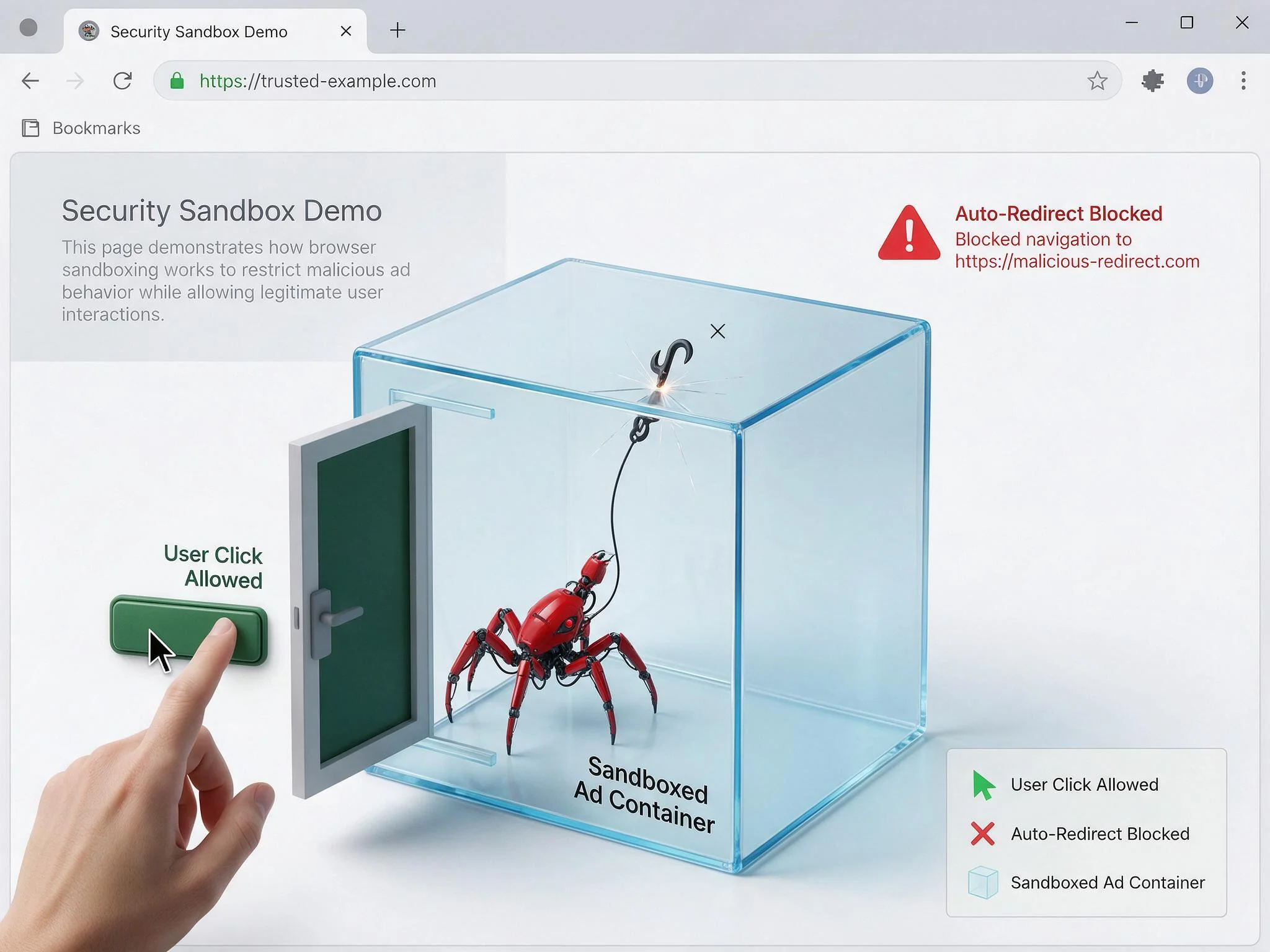
When an AdOps team inadvertently includes the legacy allow-top-navigation token instead of allow-top-navigation-by-user-activation, the sandbox permits any script inside the iframe to mutate window.top.location at any time without a physical click or tap. Replacing that token with allow-top-navigation-by-user-activation couples navigation permission directly to the browser's Transient User Activation state (navigator.userActivation.isActive). The browser kernel verifies that a genuine hardware input event (pointerdown, mousedown, or touchend) occurred inside the iframe's coordinate space within a short transient window (typically 5 seconds in Chromium) before permitting a top-level redirect or popup creation. Synthetic events generated via element.click() or dispatchEvent() lack the browser's internal isTrusted = true flag and do not grant transient user activation, causing the browser to block the forced redirect and log a security violation to the console.
Equally critical to buyer yield is the allow-popups-to-escape-sandbox token. Most programmatic creatives open their click-through landing pages in a new browsing context using <a target="_blank"> or window.open(). By default, when a sandboxed iframe spawns a new tab via allow-popups, the newly opened tab inherits the exact same sandbox flag set as the parent ad iframe. If the ad iframe does not include allow-popups-to-escape-sandbox, the advertiser's landing page loads inside an opaque-origin sandbox where cookies, localStorage, and third-party payment scripts are blocked. The user sees a broken landing page, post-click conversion rates collapse, and DSPs apply severe bid shading or block the publisher's supply path due to poor return on ad spend (ROAS).
Below is a production-grade JavaScript module for enforcing strict sandbox token policies when rendering Prebid.js 11.x winning bids into isolated containers:
/**
 * Sky Boosts Hardened Ad Slot Renderer for Prebid.js 11.x
 * Enforces opaque origin isolation, user-activated navigation, and unsandboxed landing tabs.
 */
function renderHardenedAdSlot(mountNode, adHtmlPayload, width, height) {
  const iframe = document.createElement('iframe');

  // Strict sandbox policy: NO allow-top-navigation, NO allow-same-origin on srcdoc
  const allowedTokens = [
    'allow-scripts',
    'allow-forms',
    'allow-popups',
    'allow-popups-to-escape-sandbox',
    'allow-top-navigation-by-user-activation'
  ];

  iframe.setAttribute('sandbox', allowedTokens.join(' '));
  iframe.setAttribute('width', String(width));
  iframe.setAttribute('height', String(height));
  iframe.setAttribute('frameborder', '0');
  iframe.setAttribute('scrolling', 'no');
  iframe.setAttribute('marginwidth', '0');
  iframe.setAttribute('marginheight', '0');

  // Restrict powerful browser APIs via Permissions-Policy
  iframe.setAttribute(
    'allow',
    'autoplay \'none\'; camera \'none\'; microphone \'none\'; geolocation \'none\'; vibrate \'none\''
  );

  // Inject creative HTML inside a minimal standards-mode document
  iframe.srcdoc = `<!DOCTYPE html><html><head><meta charset="utf-8"><style>body{margin:0;padding:0;overflow:hidden;}</style></head><body>${adHtmlPayload}</body></html>`;

  mountNode.replaceChildren(iframe);
  return iframe;
}
Note the inclusion of the allow attribute configuring the Permissions-Policy on the iframe. Malicious creatives frequently invoke navigator.vibrate([500, 200, 500]) on Android devices to simulate system malware alerts alongside fake modal dialogs. Explicitly disabling vibrate, autoplay, and hardware sensors at the iframe boundary neutralizes sensory-spoofing attacks.
Transitioning from Legacy SafeFrame to IAB SHARC v1.0 (Safe Ad Container)
When isolating an ad inside a cross-origin or opaque-origin sandboxed iframe, a major functional trade-off emerges: the creative loses direct visibility into its position within the publisher's viewport. Without access to window.top, scripts inside the sandbox cannot read parent scroll events or measure element intersection via standard DOM traversal, and expandable rich media formats cannot resize their container dynamically.
In 2014, the IAB introduced SafeFrame 1.1 to solve this via a cross-domain postMessage bridge ($sf.ext). While SafeFrame remains available in Google Ad Manager (enabled by default on standard GPT slots), the legacy SafeFrame specification suffers from significant architectural bottlenecks in modern programmatic environments:
- Synchronous Initialization Overhead: Legacy SafeFrame relies on heavy host-side and client-side JavaScript libraries that must handshake before rendering creative assets, increasing time-to-first-frame latency and hurting viewability rates on fast-scrolling mobile web feeds.
- Fragmented Viewability Telemetry: SafeFrame 1.1 predated the widespread adoption of native browser
IntersectionObserverv2 and the IAB Open Measurement (OM Web) SDK, forcing verification vendors to rely on polling geometry messages that can drop frames under main-thread CPU contention. - Inconsistency Across Non-GAM Supply Paths: Publishers running direct Prebid.js rendering or custom ad servers outside GPT rarely implemented the complex SafeFrame host library, creating inconsistent container APIs for DSP rich media creatives.
To modernize cross-origin ad containment, the IAB Tech Lab introduced the Safe HTML Ad Rich Container (SHARC 1.0) specification. SHARC 1.0 defines a standardized, lightweight asynchronous communication protocol between the host page and a strictly sandboxed cross-origin ad container. Unlike legacy SafeFrame, SHARC is designed from the ground up around modern browser primitives (IntersectionObserver, ResizeObserver, and structured clone postMessage channels) and integrates natively with Open Measurement Web Video and Display verification standards.
| Architectural Feature | Friendly Iframe (about:blank) |
Legacy IAB SafeFrame 1.1 | IAB SHARC 1.0 Container |
|---|---|---|---|
| Origin Isolation | Same-Origin (Zero isolation) | Cross-Origin | Cross-Origin or Opaque (srcdoc) |
| Forced Redirect Protection | None (Full window.top write access) |
Relies on sandbox token config |
Enforces allow-top-navigation-by-user-activation |
| Host Page Cookie / DOM Access | Unrestricted read/write | Blocked by Same-Origin Policy | Blocked by Same-Origin Policy & Sandbox |
| Viewability Measurement | Direct DOM traversal | Custom $sf.ext.inViewPercentage() polling |
Native IntersectionObserver + OM SDK Bridge |
| Container Resize / Expansion | Direct frameElement.style mutation |
$sf.ext.expand() API |
Asynchronous sharc.requestResize() with host policy check |
Under SHARC 1.0, the host page initializes a Secure Host Controller that spawns the sandboxed iframe and establishes a dedicated MessageChannel. All geometry updates, viewport intersection ratios, and lifecycle events (init, 曝光/viewable, resize, unload) are pushed to the container asynchronously without polling the main thread. When a creative requests a container resize or expansion, the SHARC host controller validates whether the requested dimensions comply with the publisher's layout constraints and whether transient user activation is present before mutating the slot CSS. Publishers looking to verify how Sky Boosts validates container integrity and supply-chain safety can review our trust and security certifications.
Using Content Security Policy (CSP) and iframe csp Attributes to Catch Rogue Scripts
While HTML5 sandboxing and SHARC 1.0 prevent a rendered creative from hijacking the top-level window or reading publisher cookies, they do not stop a compromised creative from making unauthorized network requests to known malware distribution hosts inside its own frame. To gain network-level visibility and block unauthorized third-party script chains before they execute, engineering teams must pair sandboxed iframes with Content Security Policy (CSP) controls and real-time W3C Reporting API telemetry.
Applying a blanket, restrictive script-src CSP header to the publisher's top-level HTML document is historically difficult in programmatic advertising because header bidding wrappers and downstream DSP tags dynamically load hundreds of verification, attribution, and CDN domains. However, publishers can deploy targeted CSP strategies at two levels without breaking programmatic fill:
- Top-Level Report-Only Telemetry and
frame-ancestorsEnforcement: Deploying aContent-Security-Policy-Report-Onlyheader on the main document that monitors unexpectedframe-srcorscript-srcorigins and streams violation payloads to a real-time intake endpoint via thereport-todirective. - Container-Level CSP Injection: Injecting a
<meta http-equiv="Content-Security-Policy">tag directly into the<head>of the sandboxedsrcdocad container (or utilizing Chromium'scspattribute on the<iframe>element) to enforce strict execution boundaries exclusively inside the ad slot.
By injecting a container-scoped CSP inside the ad iframe, the publisher can enforce upgrade-insecure-requests, block object-src (eliminating legacy plugin vectors), and explicitly block known malvertising command-and-control domains while attaching a reporting directive that captures the exact blocked URI and line number when a rogue script attempts to phone home.
Below is an example HTTP header configuration and container-level CSP injection pattern that captures real-time violation telemetry for automated creative quarantine:
Reporting-Endpoints: adsec-telemetry="https://telemetry.skyboosts.com/v1/csp-ingest"
Content-Security-Policy-Report-Only: default-src https: data: blob: 'unsafe-inline' 'unsafe-eval'; object-src 'none'; frame-ancestors 'self'; report-to adsec-telemetry
And inside the dynamic ad container builder on the client side:
/**
 * Injects a container-scoped CSP meta policy and listens for SecurityPolicyViolationEvents
 * to identify the exact Prebid bidId / creativeId responsible for unauthorized calls.
 */
function buildContainerDocumentWithCSP(adHtml, bidMetadata) {
  const metaCsp = `
    default-src https: data: blob:;
    script-src https: 'unsafe-inline' 'unsafe-eval';
    object-src 'none';
    base-uri 'none';
    upgrade-insecure-requests;
  `.replace(/\s+/g, ' ').trim();

  const monitorScript = `
    <script>
      document.addEventListener('securitypolicyviolation', function(e) {
        window.parent.postMessage({
          type: 'SKYBOOSTS_CSP_VIOLATION',
          bidder: ${JSON.stringify(bidMetadata.bidderCode)},
          creativeId: ${JSON.stringify(bidMetadata.creativeId)},
          adomain: ${JSON.stringify(bidMetadata.adomain || [])},
          blockedURI: e.blockedURI,
          violatedDirective: e.violatedDirective
        }, '*');
      });
    <\/script>
  `;

  return `<!DOCTYPE html><html><head><meta charset="utf-8"><meta http-equiv="Content-Security-Policy" content="${metaCsp}">${monitorScript}</head><body style="margin:0;padding:0;overflow:hidden;">${adHtml}</body></html>`;
}
When the parent page receives the SKYBOOSTS_CSP_VIOLATION message from the sandboxed frame, it correlates the blockedURI with the exact OpenRTB 2.6 crid (Creative ID), adomain (Advertiser Domain), and SSP seat metadata stored during the Prebid.js auction. Instead of waiting hours for user complaints to surface, the publisher's telemetry pipeline can automatically destroy the offending iframe node in the DOM and push the crid to a server-side blocklist in Prebid Server and Google Ad Manager within seconds.
Securing programmatic inventory against forced redirects and malvertising requires treating every third-party creative as untrusted code. By eliminating friendly iframes in favor of opaque-origin containers, enforcing allow-top-navigation-by-user-activation alongside allow-popups-to-escape-sandbox, transitioning rich media slots to IAB SHARC 1.0, and binding DOM securitypolicyviolation listeners to auction metadata, publishers can neutralize client-side redirect vectors while preserving 100% viewability measurement and landing page conversion integrity.