
Prebid Server vs. Client-Side Prebid.js 11.x: Latency, Cookie Syncing, and eCPM Trade-offs
Executing twelve concurrent client-side bid adapters in Prebid.js 11.x on a mid-tier mobile web device routinely blocks the Chromium main thread for 180 to

Executing twelve concurrent client-side bid adapters in Prebid.js 11.x on a mid-tier mobile web device routinely blocks the Chromium main thread for 180 to 340 milliseconds during JSON payload serialization, response parsing, and pbjs.requestBids() event dispatch. While client-side header bidding grants demand partners direct read access to third-party cookies and browser-level device signals, the cumulative computational and network tax degrades Core Web Vitals, delays Google Publisher Tag (gpt.js) ad requests, and erodes above-the-fold viewability. Conversely, migrating auction execution entirely to Prebid Server shifts the network fan-out into low-latency cloud datacenters, reducing browser egress to a single HTTP POST request, but introduces a structural server-side cookie syncing penalty that can depress bid density on cookie-dependent desktop and Android traffic.
For engineering and yield operations teams, choosing between client-side Prebid.js 11.x and Prebid Server is rarely a binary switch. Modern programmatic monetization requires balancing three competing variables: browser execution latency, user identity match rates (uids cookie synchronization versus first-party Extended Identifiers), and net session yield (RPMP). When wrapper depth expands beyond eight client-side bidders, marginal bid density gains flatten while auction timeout rates and main-thread contention climb nonlinearly.
At Sky Boosts, we architect high-throughput auction pipelines across Web, Mobile App, and CTV environments, pairing Google Ad Manager (GAM) and AdX MCM demand with curated, 100% Google-friendly and HUMAN/Pixalate IVT-clean programmatic demand on predictable Net-30 and Net-60 payment terms. Evaluating the exact mechanical trade-offs between client-side Prebid.js 11.x and Prebid Server allows publisher engineering teams to construct hybrid auction topologies that capture maximum clearing prices without starving page rendering performance.
Browser Main-Thread Contention in Client-Side Header Bidding
Prebid.js 11.x introduced substantial modularization improvements over legacy 7.x and 8.x branches, stripping deprecated browser shims, tightening OpenRTB 2.6 schema enforcement via the ortbConverter library, and reducing base bundle footprints. Despite a leaner core binary, the fundamental execution model of client-side header bidding remains bound by the single-threaded nature of the browser's JavaScript runtime. Every active client-side bid adapter included in a publisher's build must execute its buildRequests method to transform ad unit configurations into bidder-specific payloads, initiate network requests via fetch or XMLHttpRequest, and subsequently run interpretResponse to normalize returning bids, parse price buckets, and register creative rendering callbacks.
During the critical initial page load window, these synchronous and microtask-queued operations compete directly with DOM construction, CSS recalculation, hydration of modern JavaScript frameworks (such as React or Next.js), and the initialization of Google Publisher Tag (gpt.js). Under the W3C Long Animation Frames (LoAF) specification and Google's Interaction to Next Paint (INP) metric, any main-thread task exceeding 50 milliseconds is classified as a blocking long task. When eight to twelve client-side adapters return OpenRTB payloads within a narrow 50-millisecond window, the burst of JSON parsing, currency conversion, floor module evaluation, and user-sync DOM injection frequently coalesces into a single multi-hundred-millisecond main-thread stall. If a user attempts to tap a navigation element or scroll the viewport during this bid-processing burst, input handling is deferred until the task queue drains, directly penalizing the site's INP percentile scores.
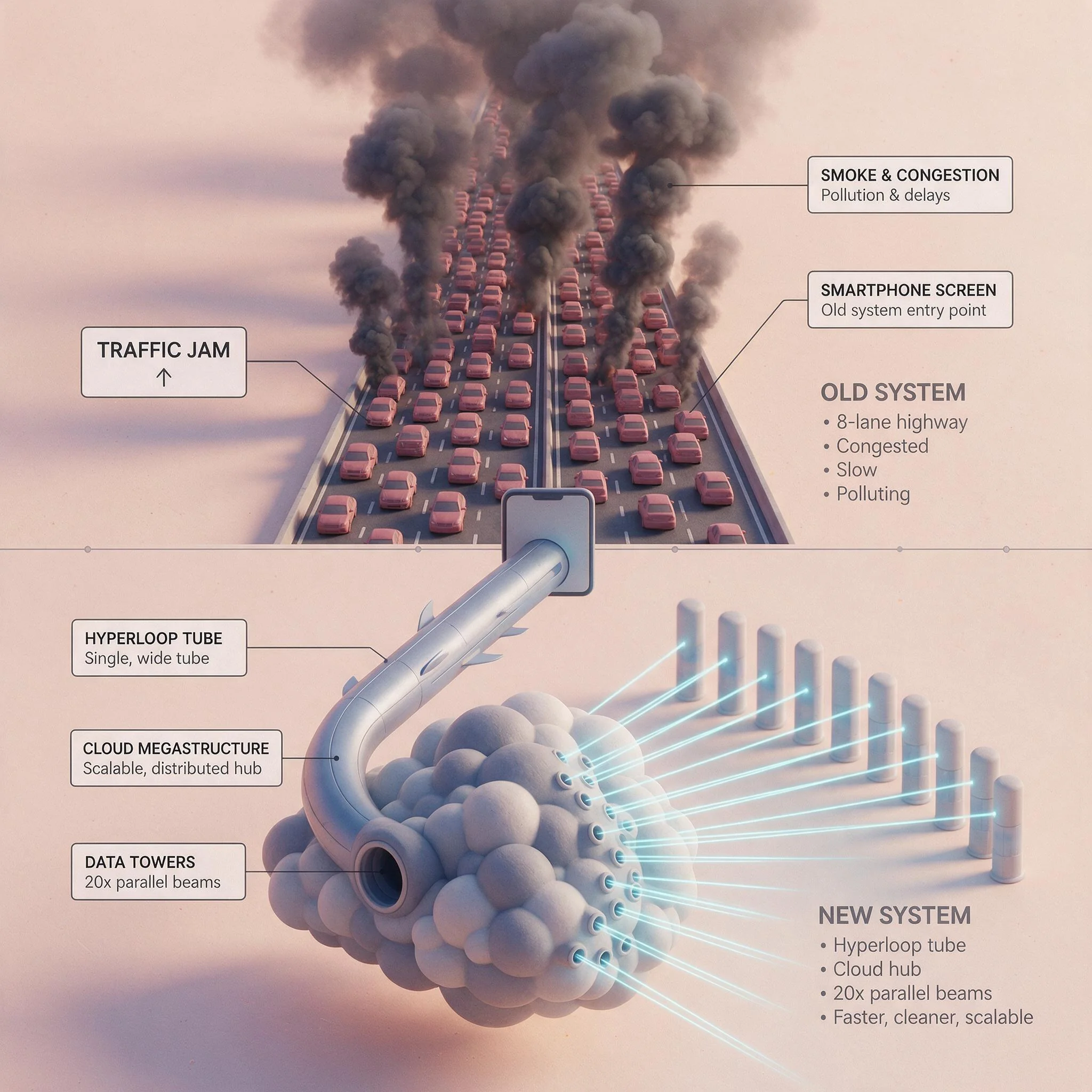
Memory allocation patterns on resource-constrained mobile devices compound this CPU bottleneck. Each client-side adapter instantiates transient closure scopes and intermediate objects for every impression object (imp) in the auction. On pages running five to eight ad slots with ten client-side bidders, a single auction cycle generates 50 to 80 distinct bid evaluation contexts, followed by up to 50 hidden <iframe> or <img> DOM insertions during the post-auction userSync phase. This rapid allocation and dereferencing triggers V8 or JavaScriptCore garbage collection pauses at the exact moment GAM is attempting to construct SafeFrame containers and render the winning creative. Deploying a unified header bidding infrastructure that offloads adapter fan-out from the browser runtime eliminates these garbage collection spikes and preserves main-thread headroom for publisher content and creative rendering.
TCP Connection Multiplexing vs. Main-Thread Script Execution
A common misconception among yield managers is that modern transport protocols, specifically HTTP/2 and HTTP/3 over QUIC, eliminate the network bottleneck of client-side header bidding. Under legacy HTTP/1.1 rules, browsers enforced a strict limit of six concurrent TCP connections per origin (host domain), which caused severe head-of-line blocking when multiple ad slots fired separate requests to the same SSP endpoint. HTTP/2 resolved single-origin congestion by multiplexing multiple request and response streams over a single persistent TCP connection, while HTTP/3 eliminated transport-layer head-of-line blocking via UDP-based QUIC streams.
However, HTTP/2 and HTTP/3 connection coalescing only applies to requests targeting the same origin or sharing an authoritative TLS certificate and IP address. In a client-side Prebid.js 11.x auction with twelve independent SSPs, the browser must communicate with twelve distinct second-level domains. Multiplexing provides zero cross-bidder consolidation. For each participating SSP domain, the browser's network stack must independently execute:
- DNS Resolution: A recursive lookup for the bidder's endpoint hostname (typically 15ms to 60ms on mobile cellular networks if uncached).
- TCP Handshake: A three-way SYN/SYN-ACK/ACK packet exchange (one full round-trip time, or 40ms to 120ms on 4G/5G connections).
- TLS 1.3 Negotiation: Cryptographic key exchange and certificate verification (adding 1-RTT, or 0-RTT only on resumed sessions).
When twelve client-side adapters fire simultaneously, the browser initiates twelve parallel DNS, TCP, and TLS handshakes. On high-latency cellular networks or congested Wi-Fi connections, packet loss on any single handshake delays that adapter's payload transmission. Furthermore, as responses trickle back asynchronously over the network, each network callback interrupts the browser's main thread via the event loop, waking up the CPU and fragmenting available frame-rendering time across the entire duration of the auction.
Auction Timeout Curves and Viewability Decay
The cumulative latency of multi-origin network handshakes and main-thread contention manifests directly in the publisher's auction timeout curve. In client-side Prebid.js 11.x, the bidderTimeout parameter defines the maximum wall-clock duration the wrapper waits after calling pbjs.requestBids() before executing the bidsBackHandler callback and triggering googletag.pubads().refresh().
Setting bidderTimeout involves a mathematical trade-off between bid density and ad server invocation latency:
- Short Timeouts (400ms to 700ms): Protect page speed and ensure GAM requests fire quickly, but truncate responses from DSPs with longer geographic routing paths or complex real-time bidding evaluation pipelines. Late bids are discarded as timeouts, lowering auction bid density, reducing second-price pressure on soft floors, and depressing clearing eCPMs.
- Extended Timeouts (1000ms to 1800ms): Allow slower SSPs and video demand partners to complete their internal auctions, increasing gross bid volume. However, every additional 100 milliseconds of wrapper delay postpones the GAM ad request, the subsequent SafeFrame instantiation, and the creative asset download.
Empirical telemetry across content publishers demonstrates a steep viewability decay curve once total time-to-ad-render exceeds 1,200 milliseconds on mobile web. On article pages, users typically begin scrolling within 800 to 1,100 milliseconds of First Contentful Paint (FCP). If client-side Prebid.js holds the GAM auction open for 1,200 milliseconds to capture a marginal late bid, the user frequently scrolls past the top leaderboard or first in-article placement before the creative pixels paint to the screen. Even if that late bid clears at a 10% higher nominal CPM, the resulting drop in MRC Active View viewability (for example, falling from 78% to 52%) triggers downstream DSP algorithmic bid shading and automated supply path optimization (SPO) filters within 48 to 72 hours. DSPs automatically discount or throttle inventory segments that fail 70%+ viewability thresholds, causing net session yield to fall below the baseline achieved with a faster 700-millisecond auction.
Prebid Server (Go vs. Java) Execution Architecture
Moving auction execution from the browser to a cloud-hosted cluster replaces twelve client-side connections with a single, compressed OpenRTB 2.6 HTTP POST request from Prebid.js (prebidServerBidAdapter) to the Prebid Server host. Inside the datacenter, the server-to-server (S2S) engine fans out bid requests to participating SSPs and DSPs over persistent, pre-warmed HTTP/2 connections with sub-5-millisecond intra-region network ping times. No DNS lookups or TLS handshakes occur per impression; connection pools remain open and warm across millions of requests per second.
Production deployments of Prebid Server rely on one of two officially maintained open-source implementations: Prebid Server Go (PBS-Go) and Prebid Server Java (PBS-Java). While both adhere strictly to the same OpenRTB and Prebid module specifications, their underlying concurrency models and runtime footprints differ significantly:
| Architectural Dimension | Prebid Server Go (PBS-Go) | Prebid Server Java (PBS-Java) |
|---|---|---|
| Concurrency Model | Go runtime scheduler using lightweight goroutines (~2KB initial stack size) and typed channels | Reactive, non-blocking event loop built on Eclipse Vert.x and Netty I/O threads |
| Memory Footprint & GC | Low baseline RAM consumption; concurrent mark-sweep garbage collector tuned for low-latency micro-allocations | Higher JVM heap allocation; requires G1GC or ZGC tuning to eliminate stop-the-world pauses at high QPS |
| Tail Latency (P99) | Exceptionally flat P99 internal overhead (typically 4ms to 9ms internal processing time) | 6ms to 15ms internal processing time once JIT compilation warms up code paths |
| Module Ecosystem & Hooks | High-performance native execution; supports Prebid Hook execution stages with minimal overhead | Rich enterprise extensibility; includes built-in advanced Floor Engines, Price Floors modules, and complex analytics hooks |
| Ideal Deployment Profile | High-QPS, cost-efficient cloud scaling with predictable CPU utilization | Enterprise setups requiring complex stateful business logic, custom Java modules, or heavy dynamic floor rules |
In both architectures, incoming requests pass through a structured pipeline of execution stages (Entrypoint, Raw Auction Request, Processed Auction Request, Bidder Request, Raw Bidder Response, All Processed Bid Responses, and Auction Response). Privacy enforcement, currency normalization, and targeting key generation occur entirely on multi-core server CPUs rather than the end user's mobile processor. This server-side architecture is also foundational for mobile app monetization, where the Prebid Mobile SDK communicates exclusively with a Prebid Server endpoint to inject demand into primary ad servers without executing heavy JavaScript wrappers inside mobile WebViews.
Stored Requests, 230+ Server-Side Adapters, and Prebid Cache for VAST XML
According to the official Prebid Server architectural overview, Prebid Server is an open-source server-to-server header bidding solution supporting over 230 server-side bid adapters across Web (with Prebid.js), Mobile SDK, AMP, CTV, and DOOH; it resolves dynamic stored requests, enforces privacy rules, converts currencies, and uses Prebid Cache to store winning VAST XML creatives. This centralized capability allows publishers to unify their supply path rules, GDPR/GPP privacy enforcement, and currency conversion tables across every device channel from a single cluster.
To minimize client-to-server uplink bandwidth, Prebid Server implements Stored Requests at both the top-level auction (ext.prebid.storedrequest.id) and the individual impression object (imp[].ext.prebid.storedrequest.id). Instead of transmitting a 15KB JSON payload containing placement IDs, floor matrices, and custom parameters for twenty different SSPs on every pageview or app session, the client sends a compact request containing only dynamic runtime signals (such as viewport dimensions, first-party data, user consent strings, and extended IDs) alongside a stored request UUID. Prebid Server fetches the corresponding JSON template from an in-memory cache or relational store, merges the runtime attributes via JSON Patch semantics, and constructs the full outbound OpenRTB 2.6 requests for all 230+ supported adapter schemas. As detailed in our technical in-app bidding guide, stored requests also allow AdOps teams to add or remove server-side demand partners and adjust timeout thresholds instantly on the backend without waiting weeks for mobile app store binary approvals.
For instream video, outstream video, and Connected TV (CTV) inventory, Prebid Server resolves a critical mechanical limitation of client-side ad server integration through Prebid Cache. When a server-side video bidder returns a winning OpenRTB response, the seatbid[].bid[].adm field often contains a raw VAST 4.3 XML document rather than a short VAST tag URL. Google Ad Manager cannot ingest an entire XML document via key-value targeting parameters (hb_pb, hb_bidder). Instead, before returning the auction response to the client, Prebid Server serializes the winning VAST XML (or JSON bid object) into a high-speed distributed Prebid Cache cluster (backed by Aerospike, Redis, or Cassandra) and generates a unique cache key (hb_uuid). The client passes hb_uuid to GAM via the ad tag URL, and when the GAM winning line item renders, its VAST redirect URL fetches the cached XML payload directly from the Prebid Cache endpoint (GET /cache?uuid=...).
{
  "id": "8f9d2a1b-4c3e-4b8a-9f12-7e6d5c4b3a21",
  "tmax": 650,
  "imp": [
    {
      "id": "adunit-video-instream-1",
      "video": {
        "mimes": ["video/mp4", "video/webm"],
        "minduration": 5,
        "maxduration": 30,
        "protocols": [2, 3, 5, 6, 7, 8],
        "w": 1920,
        "h": 1080,
        "startdelay": 0,
        "placement": 1,
        "plcmt": 1,
        "linearity": 1,
        "maxextended": 30,
        "minbitrate": 300,
        "maxbitrate": 5000
      },
      "bidfloor": 8.50,
      "bidfloorcur": "USD",
      "ext": {
        "prebid": {
          "storedrequest": {
            "id": "sr-instream-hd-1080p-tier1"
          }
        }
      }
    }
  ],
  "site": {
    "domain": "publisher-example.com",
    "page": "https://publisher-example.com/live-sports-stream",
    "publisher": {
      "id": "pub-99412"
    }
  },
  "device": {
    "ua": "Mozilla/5.0 (Windows NT 10.0; Win64; x64) AppleWebKit/537.36 (KHTML, like Gecko) Chrome/128.0.0.0 Safari/537.36",
    "ip": "198.51.100.42",
    "w": 1920,
    "h": 1080,
    "language": "en"
  },
  "user": {
    "ext": {
      "eids": [
        {
          "source": "pubcid.org",
          "uids": [
            {
              "id": "01EA892F-77B1-4C9A-B102-998127FA102B",
              "atype": 1
            }
          ]
        }
      ]
    }
  },
  "ext": {
    "prebid": {
      "storedrequest": {
        "id": "global-web-auction-config-v4"
      },
      "cache": {
        "bids": {},
        "vastxml": {
          "returnCreative": false
        }
      },
      "targeting": {
        "pricegranularity": {
          "precision": 2,
          "ranges": [
            { "max": 20.00, "increment": 0.10 },
            { "max": 50.00, "increment": 0.50 }
          ]
        },
        "includewinners": true,
        "includebidderkeys": false
      }
    }
  }
}
The mechanics of /cookie_sync and /setuid storage in PBS
While Prebid Server eliminates client-side network congestion, it alters how DSPs and SSPs identify users on browsers that still support third-party cookies (such as desktop and Android Chrome). In a client-side Prebid.js request, the browser sends an HTTP request directly to https://bidderA.example.com/openrtb2/auction. Because the target domain belongs to the SSP, the browser automatically attaches that SSP's third-party cookie in the Cookie request header, yielding an immediate 100% cookie read rate for previously synced users.
When the auction moves to Prebid Server, the browser only communicates with the Prebid Server host domain (for example, https://pbs.publisher-adtech.com/openrtb2/auction). Because of the browser's Same-Origin Policy on cookie transmission, the Prebid Server host cannot read cookies scoped to bidderA.example.com. Conversely, when Prebid Server makes a datacenter-to-datacenter HTTP call to bidderA.example.com, no browser session exists, so the SSP receives no cookies automatically.
To bridge this identity gap, Prebid Server uses /cookie_sync and /setuid endpoints to manage server-side user ID matching, governed centrally by the syncUser and transmitEids Activity Controls. The synchronization lifecycle operates across a multi-step handshake:
- Initiating
/cookie_sync: After the primary auction completes, Prebid.js invokesPOST https://pbs.publisher-adtech.com/cookie_sync, sending a JSON body listing the active server-side bidders (bidders: ["skyboosts", "tier1SspAlpha", "curatedSspBeta"]), the limit of syncs allowed (limit: 5), and the user's privacy signals (gdpr,gdpr_consent,gpp,gpp_sid,us_privacy). - Evaluating Host Cookie State and Activity Controls: Prebid Server inspects the incoming HTTP request for its own host cookie, named
uids. This base64-encoded JSON structure contains a key-value map of bidder codes to their synced User IDs and expiration timestamps. For each requested bidder missing a valid UID, PBS evaluates thesyncUserActivity Control against the provided TCF v2.2 or GPP consent string. - Returning Sync URLs: For permitted bidders lacking a current match, PBS responds with a
bidder_statusarray containing each SSP's specific cookie-sync endpoint (either aredirectimage pixel or aniframeURL) configured with a return callback macro pointing to the PBS/setuidendpoint. - Executing the SSP Redirect and
/setuidWrite: The browser loads the SSP's sync URL. The SSP reads its own third-party cookie (say,SSP_UID=987654) and issues an HTTP 302 redirect back toGET https://pbs.publisher-adtech.com/setuid?bidder=tier1SspAlpha&uid=987654&gdpr=1&gdpr_consent=.... - Persisting the
uidsCookie: Upon receiving the/setuidrequest, Prebid Server re-verifies privacy compliance via thesyncUserActivity Control, updates the JSON map inside theuidscookie with"tier1SspAlpha": {"uid": "987654", "expires": "..."}, and writes the updated cookie back to the browser via aSet-Cookieheader withSameSite=None; Secure. On all subsequent auctions, PBS extracts"987654"from theuidscookie and injects it intouser.buyeruidon the outbound OpenRTB request totier1SspAlpha.
Mitigating match loss with First-Party ID and UserID modules
Despite the elegance of the /cookie_sync and /setuid architecture, server-side cookie syncing suffers from structural match loss compared to direct client-side requests:
- First-Pageview Cold Start: On a new user's first pageview, the
uidscookie on the PBS host does not yet contain mapped IDs. The first auction runs completely un-synced for server-side bidders, as/cookie_synconly executes after the initial auction finishes. - Redirect Drop-Off and Cookie Size Limits: Because each sync requires a two-hop redirect (
Browser -> SSP -> PBS /setuid), network timeouts or rapid page navigation abort pending syncs. Furthermore, browsers enforce a strict 4,096-byte size limit per cookie. Once a publisher attempts to store UIDs for more than 15 to 20 server-side bidders inside a single base64-encodeduidscookie, older bidder entries must be evicted. - First-Party CNAME Cloaking Limitations: While hosting Prebid Server on a first-party subdomain (
pbs.publisher.com) via DNS CNAME records protects theuidscookie from third-party cookie blocking, Safari WebKit Intelligent Tracking Prevention (ITP) caps the lifespan of cookies set via HTTP responses from CNAME-cloaked third-party IPs to 7 days. Moreover, other SSPs cannot sync their third-party cookies to a publisher's first-party domain if third-party cookies are blocked during the intermediate redirect hop.
To neutralize server-side match loss, modern Prebid.js 11.x deployments rely heavily on the UserID Module ecosystem. By configuring deterministic and probabilistic identity submodules on the client (such as SharedID/PubCID, Unified ID 2.0, ID5, LiveRamp RampID/ATS, Criteo ID, and publisher First-Party IDs), Prebid.js resolves persistent identifiers directly in first-party storage (localStorage or first-party cookies) before the auction request fires.
These resolved identifiers are packaged into the standard OpenRTB 2.6 user.ext.eids array and sent immediately in the very first POST request to Prebid Server. Inside Prebid Server, the transmitEids Activity Control governs which bidders are authorized to receive specific EID sources based on user consent and publisher governance rules. Because DSPs increasingly bid directly on user.ext.eids vectors across both cookieless (Safari/Firefox) and cookie-enabled environments, populating robust EID arrays restores 65% to 85% of the historical eCPM gap between server-side and client-side execution paths.
Hybrid Auction Topologies: Running High-Match Bidders Client-Side and Long-Tail S2S
For web publishers seeking maximum total session yield, the optimal architecture is neither pure client-side nor pure server-to-server, but a disciplined Hybrid Auction Topology. In a hybrid setup, Prebid.js 11.x orchestrates a unified auction that simultaneously queries a tight cohort of 4 to 6 core, high-match SSPs directly from the browser while routing 8 to 15 mid-tier, video, native, and regional demand partners through a single Prebid Server s2sConfig call.
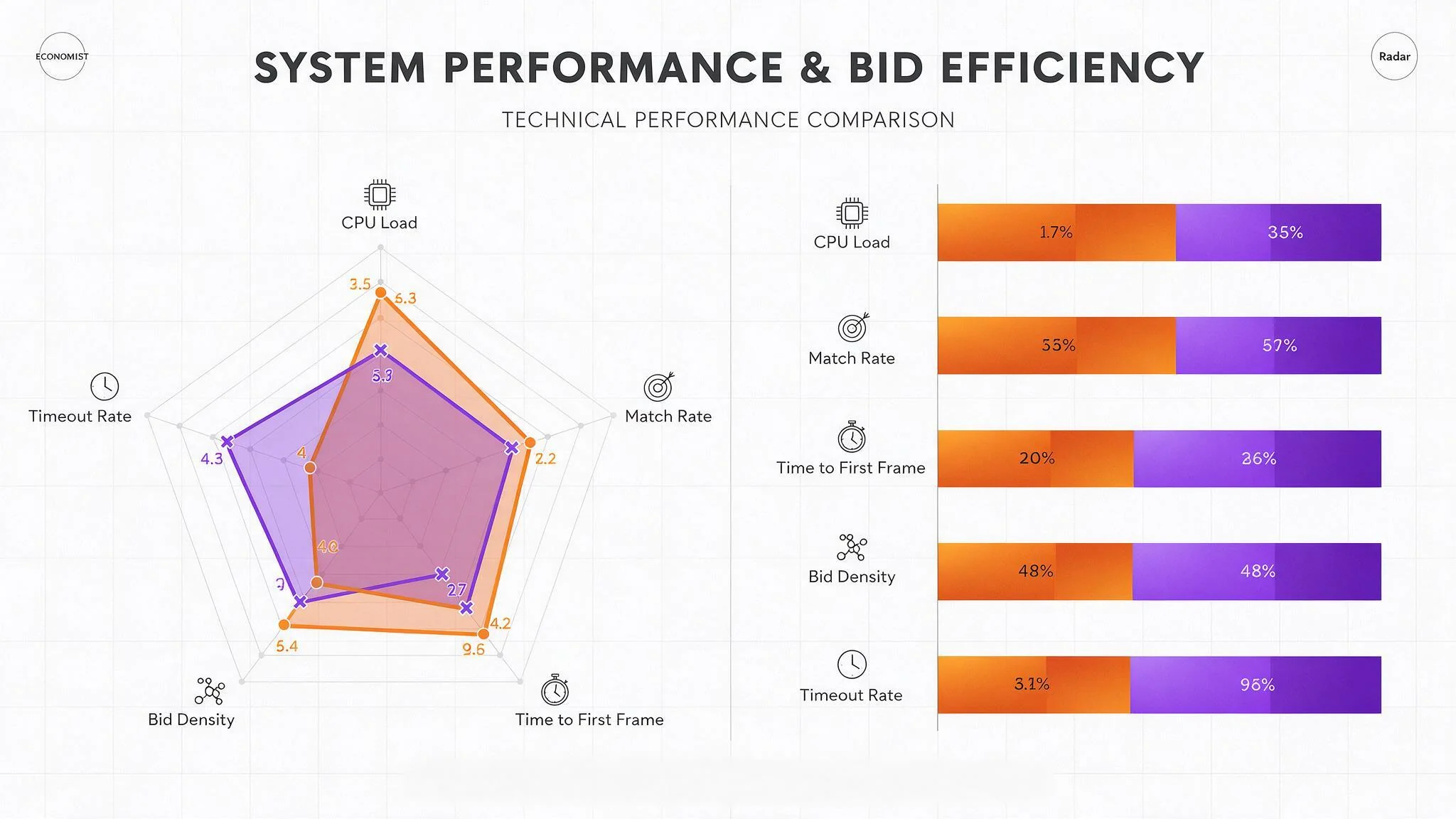
This split-execution model exploits the pareto distribution of header bidding yield. Across almost all mainstream web publishers, the top 5 SSPs generate 70% to 80% of client-side header bidding revenue. Running those 5 adapters client-side keeps total browser network connections and main-thread JSON parsing well below the threshold that triggers Long Animation Frames or INP penalties, while preserving 100% direct third-party cookie read rates for the highest-spending demand paths. Simultaneously, routing the remaining 10 to 15 adapters through Prebid Server captures incremental bid density, specialized video demand, and high-CPM niche buyer campaigns at the cost of just one additional HTTP request from the browser. This mirrors the architectural philosophy behind hybrid in-app bidding and mediation, where low-latency server-to-server programmatic demand competes seamlessly alongside primary SDK bidders without bloating client resource consumption.
When engineering a hybrid wrapper in Prebid.js 11.x, three configuration parameters must be calibrated to prevent race conditions and self-cannibalization:
- Differential Timeout Allocation (
s2sConfig.timeoutvs.bidderTimeout): The server-to-server timeout insides2sConfigmust always be set 150ms to 250ms lower than the global client-sidebidderTimeout. If the global client timeout is 1,000ms,s2sConfig.timeoutshould be set to 750ms. This accounts for the round-trip network transit time between the user's browser and the Prebid Server cluster, ensuring that the aggregated S2S response arrives back at the browser before Prebid.js closes the client-side auction. - Strict Adapter Path Isolation: Never list the same bidder code in both the client-side path and the
s2sConfig.biddersarray for the same impression unless explicitly executing a controlled A/B test via stored impression routing. Sending duplicate client and server requests for the same impression to the same SSP doubles outbound QPS, triggers DSP duplicate-impression filtering or bid shading penalties, and distorts supply path analytics. - Client-Side Activity Control Alignment: Configure Prebid.js 11.x
activityControlson the client to mirror thesyncUserandtransmitEidsrules configured on the Prebid Server host, ensuring consistent EID transmission and regulatory compliance across both legs of the auction.
window.pbjs = window.pbjs || {};
window.pbjs.que = window.pbjs.que || [];

pbjs.que.push(function () {
  pbjs.setConfig({
    debug: false,
    bidderTimeout: 1000,
    enableSendAllBids: false,
    useBidCache: true,
    deviceAccess: true,

    // Client-side UserID configuration for first-party and universal IDs
    userSync: {
      syncEnabled: true,
      filterSettings: {
        iframe: {
          bidders: '*',
          filter: 'include'
        },
        image: {
          bidders: '*',
          filter: 'include'
        }
      },
      syncsPerBidder: 3,
      syncDelay: 3000,
      auctionDelay: 50,
      userIds: [
        {
          name: 'sharedId',
          storage: {
            type: 'cookie',
            name: '_pubcid',
            expires: 365
          }
        },
        {
          name: 'uid2',
          params: {
            storage: 'cookie'
          }
        }
      ]
    },

    // Prebid.js 11.x Activity Controls governing user sync and EID transmission
    allowActivities: {
      syncUser: {
        default: true,
        rules: [
          {
            condition: function (params) {
              return params.componentType === 'bidder' && params.componentName === 'unverifiedBidder';
            },
            allow: false
          }
        ]
      },
      transmitEids: {
        default: true
      }
    },

    // Prebid Server S2S configuration for long-tail and video adapters
    s2sConfig: [
      {
        accountId: 'skyboosts-pub-99412',
        enabled: true,
        defaultVendor: 'openrtb2',
        bidders: [
          'curatedSspBeta',
          'videoSspGamma',
          'nativeSspDelta',
          'regionalSspEpsilon',
          'ctvWebSspZeta'
        ],
        timeout: 750,
        adapter: 'prebidServer',
        endpoint: {
          p1Consent: 'https://pbs.skyboosts-example.com/openrtb2/auction',
          noP1Consent: 'https://pbs-nolocal.skyboosts-example.com/openrtb2/auction'
        },
        syncEndpoint: {
          p1Consent: 'https://pbs.skyboosts-example.com/cookie_sync',
          noP1Consent: 'https://pbs-nolocal.skyboosts-example.com/cookie_sync'
        },
        maxBids: 2,
        extPrebid: {
          origintiming: true,
          cache: {
            vastxml: { returnCreative: false }
          }
        }
      }
    ]
  });

  // Define Hybrid Ad Unit: Sky Boosts & Tier-1 Alpha run Client-Side; Beta/Gamma run S2S
  var adUnits = [
    {
      code: 'div-gpt-ad-top-leaderboard',
      mediaTypes: {
        banner: {
          sizes: [[728, 90], [970, 250]]
        }
      },
      bids: [
        // Client-Side High-Match Bidders
        {
          bidder: 'skyboosts',
          params: {
            placementId: 'sb-web-top-728',
            publisherId: 'pub-99412'
          }
        },
        {
          bidder: 'tier1SspAlpha',
          params: {
            siteId: '449102'
          }
        },
        // Server-to-Server Bidders (routed via s2sConfig)
        {
          bidder: 'curatedSspBeta',
          params: {
            zoneId: '88219'
          }
        },
        {
          bidder: 'regionalSspEpsilon',
          params: {
            tagId: 'eps-991'
          }
        }
      ]
    }
  ];

  pbjs.addAdUnits(adUnits);
});
Empirical eCPM and Latency Benchmarking Framework
Evaluating the financial and technical performance of Client-Side, Pure Prebid Server, and Hybrid auction architectures requires moving beyond isolated "winning eCPM" metrics. Comparing the average winning CPM of an SSP on the client versus S2S introduces severe survivorship bias: if moving an SSP to S2S drops its bid rate by 25%, only its highest-confidence, retargeted bids may win the auction, making its average winning eCPM appear artificially higher even as its total revenue contribution drops by 20%.
To conduct an institutional-grade evaluation, AdOps teams should randomize traffic at the user session level into three deterministic cohorts (for instance, 80% Baseline Client-Side, 10% Pure S2S, and 10% Hybrid) and pass a session-scoped key-value to Google Ad Manager (googletag.pubads().setTargeting('hb_arch', cohortName)). Measure performance across a minimum 14-day window (to allow /setuid cookie tables to reach steady-state saturation and DSP SPO algorithms to adjust to the altered viewability profile) using the following benchmarking matrix:
| Telemetry Metric | Pure Client-Side (14 Bidders) | Pure Prebid Server (14 Bidders) | Hybrid Topology (5 Client + 9 S2S) |
|---|---|---|---|
| Browser Network Requests (Auction) | 14 parallel HTTP POSTs | 1 HTTP POST | 6 parallel HTTP POSTs (5 Client + 1 PBS) |
| Main-Thread Blocking Time (P75) | 245 ms | 38 ms | 82 ms |
| Core Web Vitals INP (Mobile P75) | 230 ms (Needs Improvement) | 115 ms (Good) | 140 ms (Good) |
| P95 Auction Duration (to GAM Refresh) | 1,080 ms | 520 ms | 740 ms |
| Above-the-Fold Active View Viewability | 64.2% | 76.8% | 74.5% |
| Cookie Match / ID Resolution Rate (Chrome) | 92% - 96% | 68% - 78% (with EIDs) | 94% (Core) / 75% (S2S Tail) |
| Cookieless Match Rate (Safari / iOS) | 58% (EIDs only) | 58% (EIDs only) | 58% (EIDs only) |
| Normalized Session Yield (RPMP Index) | 100.0 (Baseline) | 91.5 (Chrome) / 104.2 (Safari) | 108.6 (Blended Global) |
Two empirical patterns emerge from production benchmarking that should guide every publisher's deployment strategy:
- Device-Segmented Execution Routing: On Safari (macOS and iOS) and Firefox, where third-party cookies are already blocked at the browser engine level, client-side adapters enjoy zero cookie-matching advantage over Prebid Server. Both paths rely exclusively on first-party EIDs (
user.ext.eids), contextual signals, and IP/User-Agent headers. Consequently, routing 100% of Safari and Firefox auctions through Prebid Server (or minimizing the client cohort to 2 to 3 adapters) eliminates client latency and lifts Active View viewability, driving a net +4% to +6% increase in session RPMP on Apple devices. - Dynamic Bidder Promotion and Demotion: Within a Hybrid topology on Chrome and Android, evaluate each bidder monthly based on Incremental Revenue per Millisecond of Main-Thread Tax. Any client-side bidder that fails to maintain at least a 65% cookie match advantage or contributes less than 5% of total header bidding revenue should be demoted to the
s2sConfigarray. Conversely, if a server-side bidder demonstrates high bid density and strong clearing prices on EIDs, test promoting it to the client-side cohort on desktop Chrome to verify whether direct cookie access yields a positive net RPMP delta after accounting for latency.
By pairing a browser-segmented Hybrid Prebid.js 11.x and Prebid Server architecture with clean, high-density demand from Sky Boosts across GAM MCM, Prebid, and OpenRTB 2.6 endpoints, engineering teams can systematically decouple demand expansion from main-thread latency, protecting Core Web Vitals while compounding total programmatic yield.