
Prebid.js 11.x Bundle Size Optimization: Custom Builds, Tree-Shaking Adapters, and TypeScript Modules
Every 100 kilobytes of unminified JavaScript added to a client-side header bidding wrapper costs between 35 and 60 milliseconds of V8 parse, compile, and

Every 100 kilobytes of unminified JavaScript added to a client-side header bidding wrapper costs between 35 and 60 milliseconds of V8 parse, compile, and execution time on a mid-tier mobile CPU. When a publisher serves a bloated prebid.js bundle over a cellular connection, that main-thread execution delay occurs directly inside the critical rendering path before pbjs.requestBids() can dispatch a single OpenRTB network request. In high-concurrency web environments, wrapper weight is not merely a front-end page speed metric; it is a primary determinant of auction timeout curves, bid density, and final clearing prices inside Google Ad Manager (GAM).
When the browser main thread is congested by evaluating unused adapter closures, the entire header bidding lifecycle shifts rightward on the page load timeline. Participating SSP partners receive bid requests later, leaving less time for DSPs to complete their internal auction and return a response before the wrapper's bidderTimeout threshold expires. Even when bids arrive on time, excessive JavaScript execution delays the invocation of googletag.pubads().refresh(), depressing viewability scores and eroding yield across both AdX and header bidding demand channels.
Engineering teams upgrading to the Prebid.js 11.x architecture have an immediate opportunity to eliminate this structural latency. By auditing module dependencies, compiling deterministic builds via Gulp, offloading heavy identity and telemetry processing, and adopting Prebid 11.0's TypeScript module specifications alongside edge Brotli compression, publishers can reduce wrapper payload sizes by 55% to 70% while improving effective CPM (eCPM) stability.
The Hidden Cost of Including Unused Adapters in prebid.js
A common anti-pattern in publisher ad stacks is deploying a master prebid.js binary that contains dozens of inactive bidder adapters, legacy polyfills, and dormant real-time data (RTD) modules accumulated over years of ad operations testing. Many AdOps teams assume that if a bidder code is omitted from the active adUnits[].bids configuration array, its adapter code remains inert in the browser. From a JavaScript engine perspective, that assumption is false.
When the browser downloads prebid.js, the V8 or JavaScriptCore engine must parse the entire source text into an Abstract Syntax Tree (AST), compile the bytecode, and execute every top-level module registration wrapper before the pbjs.que command queue can process a single instruction. Every included bidder adapter invokes registerBidder(spec) during initial script evaluation, allocating memory on the heap, initializing helper closures from the shared /libraries/ directory, and binding event listeners to the core auction lifecycle. Because of this eager evaluation model, the Prebid.org developer documentation on getting started explicitly specifies that Prebid.js packages should be compiled or downloaded with only the publisher's active bidder adapters, analytics adapters, and functional modules to minimize browser payload size and main-thread parse time.
The performance penalty of dormant modules compounds across three distinct operational dimensions:
- Main-Thread Contention and Core Web Vitals: Each inactive bidder adapter adds roughly 8 KB to 25 KB of unminified source code. Carrying 25 unused adapters inflates the uncompressed bundle by nearly 400 KB. During page hydration, parsing this dead weight blocks the main thread, spiking Total Blocking Time (TBT) and degrading Interaction to Next Paint (INP) when users attempt to scroll or tap during initial ad slot initialization.
- Shared Library Bloat: Prebid adapters share utility functions for OpenRTB 2.6 object transformation (
ortbConverter), banner sizing, outstream video rendering, and user sync management. Including a single unused video-capable adapter can force the bundler to retain heavy XML validation and VAST wrapper utilities that would otherwise be excluded from a display-only build. - Timeout Cannibalization: In a 1000-millisecond auction window, losing 120 milliseconds to script parsing and AST compilation leaves only 880 milliseconds for network round-trip latency and DSP bid evaluation. As late bids miss the
sendAdserverRequestcutoff, bid density drops, floor elasticity weakens, and GAM defaults to lower-yielding remnant line items or unfilled impressions.
Deploying custom Prebid builds tailored to the exact demand stack of each property eliminates these hidden execution taxes. Rather than maintaining a monolithic global script across all sites, institutional publishers enforce strict build profiles that map strictly to active supply path optimization (SPO) partners.
Building a Lean Custom Bundle with Gulp (gulp build --modules=...)
Compiling Prebid.js directly from source inside a continuous integration (CI) pipeline gives engineering teams granular control over every kilobyte shipped to the client. While the Prebid.org download page provides a convenient web interface for manual compilation, production ad stacks require reproducible, version-controlled builds driven by the official Gulp toolchain and Webpack tree-shaking pipeline.
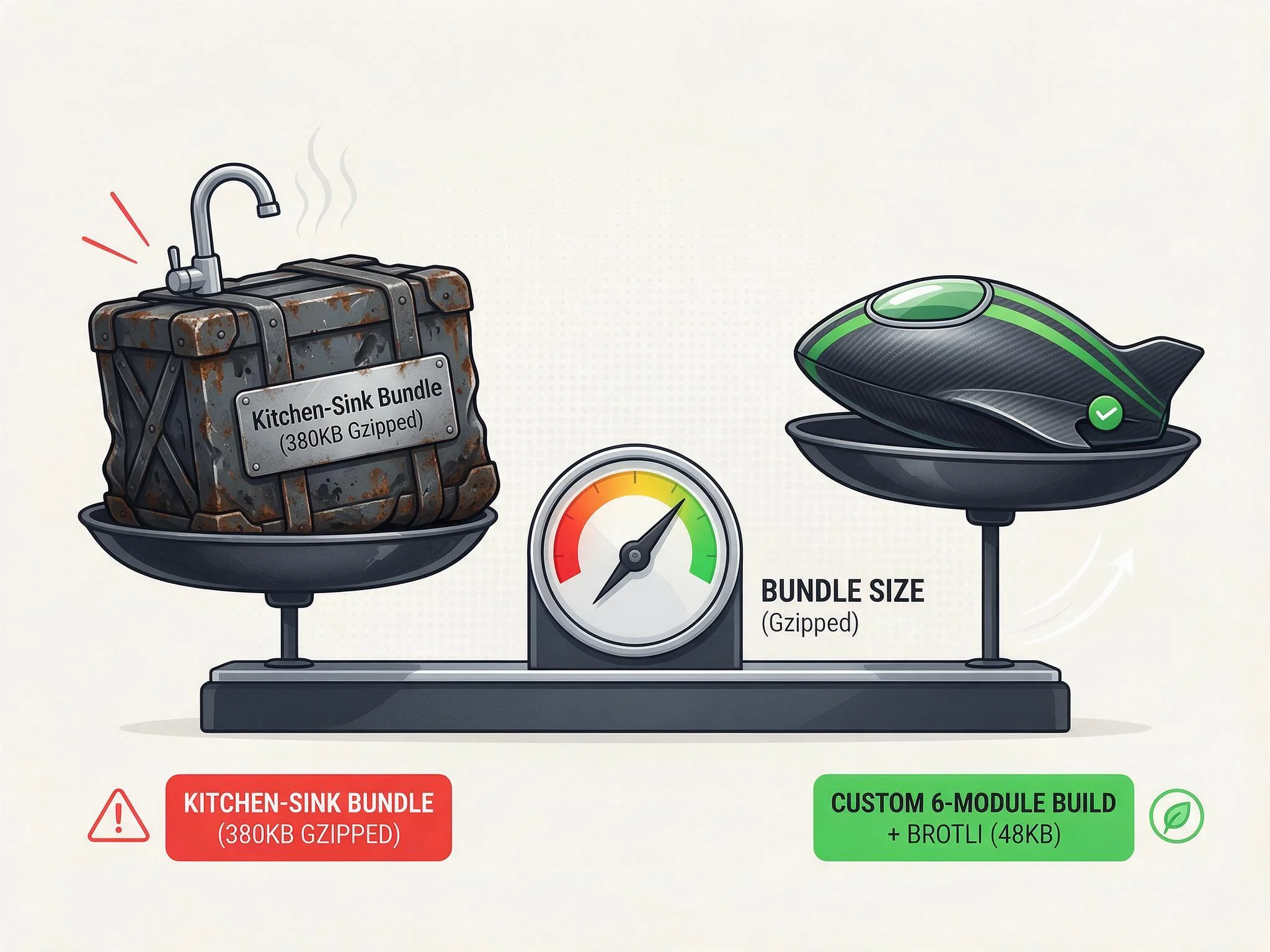
When building from the Prebid.js 11.x repository, the Gulp build task reads a deterministic list of required modules and constructs a dependency graph that strips out every unreferenced adapter and library helper. Instead of passing a long comma-separated string to the --modules CLI flag, production pipelines maintain a dedicated modules.json file checked into source control alongside the publisher's wrapper configuration.
[
  "consentManagementTcf",
  "consentManagementUsp",
  "GPPControl_usnat",
  "gptPreAuction",
  "priceFloors",
  "currency",
  "schain",
  "ortb2bidding",
  "userId",
  "sharedIdSystem",
  "pbsBidAdapter",
  "skyboostsBidAdapter"
]
With the module manifest defined, the CI runner executes the compilation step using Node.js and Gulp:
# Clone the specific Prebid 11.x release tag for deterministic builds
git clone --depth 1 --branch 11.0.0 https://github.com/prebid/Prebid.js.git
cd Prebid.js
npm ci

# Compile the production bundle with only the specified modules
npx gulp build-bundle-prod --modules=/path/to/modules.json --bundleName=prebid.lean.js
Under the hood, gulp build-bundle-prod invokes Babel and Webpack with production minification (TerserPlugin) enabled. Because Prebid 11.x enforces ES module (import / export) syntax across its internal /src/ and /modules/ directories, Webpack performs static analysis to tree-shake unused exports from shared utility libraries. For example, if the active adapters in modules.json only reference banner and native media types, any unreferenced video helper methods inside libraries/video/ are omitted from the final build/dist/prebid.lean.js output.
AdOps teams should pair this build step with automated size budgets in their CI pipeline. If a pull request adds a new bidder adapter or RTD submodule that pushes the minified bundle over a strict threshold (such as 140 KB pre-compression), the CI check alerts the monetization engineering team to audit the adapter's dependency footprint before deploying to production.
Separating Core Prebid Logic from Heavy Analytics and ID Modules
Pruning inactive bidder adapters solves only half of the bundle weight problem. When auditing production wrappers, engineering teams frequently discover that functional modules, specifically User ID submodules, client-side analytics adapters, and real-time data (RTD) providers, consume 45% to 60% of the compiled file size.
Every client-side analytics adapter bundled into prebid.js subscribes to the internal events.on() bus, listening for auctionInit, bidRequested, bidResponse, bidTimeout, and auctionEnd. Heavy analytics modules buffer these high-frequency events in memory, serialize nested OpenRTB payload objects, and load external tracking scripts onto the page. Similarly, stacking seven or eight User ID submodules forces the wrapper to parse multiple cryptographic hashing helpers, cookie-jar parsers, and local storage polling loops before the first auction can initialize.
To keep the core client-side auction engine fast, high-yield publishers decouple heavy telemetry and identity resolution from the browser thread using three architectural patterns:
- Offloading Identity and Demand to Prebid Server: By routing complex multi-SSP auctions through
pbsBidAdapterto a managed Prebid Server (Go or Java) cluster, publishers can replace ten client-side bidder adapters with a single server-to-server (S2S) adapter. This architecture mirrors the low-latency patterns detailed in our in-app bidding guide, where client SDK footprints must remain minimal to preserve application stability and battery life. - Server-Side Analytics Aggregation: Instead of executing three separate analytics adapters in the browser, publishers connected to our unified monetization platform capture auction telemetry server-side via Prebid Server analytics modules or emit a single, lightweight
navigator.sendBeacon()payload atauctionEnd. - Deferred User Sync and Storage Throttling: For identity submodules that must remain on the client (such as
sharedIdSystemor first-party publisher IDs), delaying synchronization prevents identity HTTP calls from competing with critical auction and GPT requests for browser network sockets.
window.pbjs = window.pbjs || {};
window.pbjs.que = window.pbjs.que || [];

pbjs.que.push(function() {
  pbjs.setConfig({
    debug: false,
    bidderTimeout: 1000,
    enableSendAllBids: false,

    // Defer identity syncing until after the primary auction clears
    userSync: {
      syncEnabled: true,
      syncDelay: 3500,
      syncsPerBidder: 3,
      filterSettings: {
        iframe: {
          bidders: '*',
          filter: 'include'
        }
      },
      userIds: [{
        name: 'sharedId',
        storage: {
          type: 'cookie',
          name: '_pubcid',
          expires: 365
        }
      }]
    },

    // Offload multi-partner demand to Prebid Server to keep client bundle lean
    s2sConfig: [{
      accountId: 'sb-pub-99412',
      bidders: ['curatedSspA', 'curatedSspB'],
      defaultVendor: 'openrtb2',
      enabled: true,
      timeout: 750,
      endpoint: 'https://pbs.skyboosts.com/openrtb2/auction',
      syncEndpoint: 'https://pbs.skyboosts.com/cookie_sync'
    }]
  });
});
By setting syncDelay: 3500 and consolidating secondary demand partners into s2sConfig, the browser dedicates 100% of its initial CPU and network capacity to resolving the primary auction and rendering GAM creative slots.
Moving to TypeScript Modules in Prebid 11.0 and Serving with Brotli Compression (br)
The release of Prebid.js 11.0 introduced major structural modernizations designed to shrink repository overhead and improve compile-time optimization. According to the official Prebid.js 11.0 release notes, TypeScript is now preferred over JavaScript for module development, and 16 legacy modules (including adpod, express, and paapi) were stripped from the repository. Removing deprecated modules such as the Protected Audience API (paapi) integration, legacy adpod long-form video handlers, and express wrapper scripts immediately cleans up internal type definitions and eliminates vestigial code paths from core auction processors.
Writing custom bidder adapters and RTD modules in TypeScript (modules/myAdapter.ts) yields direct bundle size benefits beyond developer ergonomics. When modules are authored against Prebid's strict TypeScript interfaces (BidderSpec<BidderCode>, BidRequest, and ORTBRequest), structural validation happens at compile time rather than runtime. In legacy JavaScript adapters, developers routinely wrote defensive runtime helper functions to verify nested object properties, array types, and parameter signatures. In Prebid 11.x TypeScript modules, the compiler strips all interface declarations and type annotations during transpilation, emitting lean, predictable ES6 code that integrates directly with ortbConverter.
import { registerBidder } from '../src/adapters/bidderFactory.ts';
import { BANNER, VIDEO } from '../src/mediaTypes.ts';
import { ortbConverter } from '../libraries/ortbConverter/converter.ts';
import type { BidderSpec } from '../src/adapters/bidderFactory.ts';

const BIDDER_CODE = 'skyboosts';
const ENDPOINT_URL = 'https://rtb.skyboosts.com/openrtb2/bid';

const converter = ortbConverter({
  context: {
    netRevenue: true,
    ttl: 300
  }
});

export const spec: BidderSpec<typeof BIDDER_CODE> = {
  code: BIDDER_CODE,
  supportedMediaTypes: [BANNER, VIDEO],

  isBidRequestValid: (bid): boolean => {
    return Boolean(bid?.params?.placementId && bid?.params?.publisherId);
  },

  buildRequests: (validBidRequests, bidderRequest) => {
    const data = converter.toORTB({ validBidRequests, bidderRequest });
    return {
      method: 'POST',
      url: ENDPOINT_URL,
      data
    };
  },

  interpretResponse: (serverResponse, request) => {
    return converter.fromORTB({
      response: serverResponse.body,
      request: request.data
    }).bids;
  }
};

registerBidder(spec);
Notice how delegating payload construction and response parsing to the shared ortbConverter library keeps the entire TypeScript bidder adapter under 45 lines of code. When compiled alongside other adapters that also import ortbConverter, Webpack bundles the converter logic only once, reducing marginal cost per additional bidder to less than 2 KB.
Once the TypeScript build pipeline outputs the minified prebid.lean.js artifact, the final optimization layer happens at the CDN edge via Brotli (br) compression. Standard Gzip (gzip -9) compression relies on the LZ77 algorithm and Huffman coding, typically achieving a 68% to 72% reduction on minified JavaScript. Brotli compression (Content-Encoding: br), supported by all modern Chromium, WebKit, and Gecko browsers over HTTPS, utilizes a pre-defined static dictionary of common web and JavaScript tokens alongside context modeling.
Because prebid.js contains repetitive OpenRTB field names, standard DOM API calls, and recurring adapter structures, pre-compressing the bundle during the CI build phase at Brotli quality level 11 (brotli -q 11 prebid.lean.js) shrinks wire transfer payloads by an additional 18% to 24% compared to Gzip.
# NGINX Edge Configuration for Pre-Compressed Prebid 11.x Bundles
location ~* ^/wrappers/prebid\.[a-f0-9]+\.js$ {
    brotli_static on;
    gzip_static on;

    add_header Cache-Control "public, max-age=31536000, immutable";
    add_header Timing-Allow-Origin "*";
    add_header Access-Control-Allow-Origin "*";
    default_type application/javascript;
}
For engineering and AdOps teams managing high-volume web inventory, the operational takeaway is straightforward: treat wrapper byte weight as a direct auction yield variable. Audit your modules.json quarterly to prune underperforming bidders, migrate custom modules to Prebid 11.0 TypeScript interfaces backed by ortbConverter, shift heavy multi-partner auctions and analytics to Prebid Server, and serve content-hashed bundles with static Brotli level 11 compression. Shaving 150 KB of compressed JavaScript off your header bidding wrapper recovers up to 90 milliseconds of critical main-thread execution time, directly increasing bid density, raising GAM AdX competition, and protecting publisher Net-30 and Net-60 revenue streams.