
Mobile App Memory Management: Preventing WebView OOM Crashes from MRAID 3.0 and SHARC Creatives
When iOS terminates a foreground application via JetsamEvent with a per-process-limit exception, or Android throws a fatal java.lang.OutOfMemoryError inside

When iOS terminates a foreground application via JetsamEvent with a per-process-limit exception, or Android throws a fatal java.lang.OutOfMemoryError inside the RenderThread, the root cause in ad-supported applications is frequently an orphaned or unconstrained WebView instance executing rich media creative code. Modern programmatic demand relies heavily on HTML5 playables, interactive video overlays, and WebGL canvases to drive high eCPMs. Unlike static bitmap banners that occupy predictable memory buffers, rich media ads spin up complete browser rendering engines inside the host application. Without strict lifecycle destruction, native bridge decoupling, and server-side payload filtering, a single sixty-second session with banner refreshes and full-screen placements can exhaust the memory ceiling of mainstream mobile hardware.
For engineering teams balancing user retention against mobile app monetization, WebView memory pressure represents a direct revenue leak. When an ad creative crashes the host process before the impression pixel fires or before the user completes a rewarded interaction, the publisher loses both the clearing price of that auction and the downstream lifetime value of the truncated session. Furthermore, platform vitals algorithms on both Google Play and the Apple App Store penalize applications whose crash-free session rates fall below category thresholds, directly suppressing organic store visibility.
Eliminating ad-induced out-of-memory (OOM) crashes requires a defense-in-depth architecture spanning three layers: deterministic native view teardown at the client SDK layer, dynamic payload and bitrate shaping at the OpenRTB 2.6 exchange layer, and sandboxed container execution via modern industry specifications such as MRAID 3.0 and IAB SHARC 1.0.
How Poorly Coded Ad Creatives Leak Memory in iOS WKWebView and Android WebView
Understanding how an HTML5 advertisement destabilizes a native mobile application requires examining how iOS and Android allocate memory for embedded browser instances. On iOS, WKWebView executes web content out-of-process using the com.apple.WebKit.WebContent and com.apple.WebKit.GPU daemon processes. In theory, if an ad creative allocates an excessive JavaScript heap or decodes massive uncompressed textures, the operating system should terminate only the WebContent subprocess and invoke webViewWebContentProcessDidTerminate(_:) on the host application's WKNavigationDelegate. In practice, two failure modes bypass this isolation and crash the main application process directly: retain cycles across the Objective-C/Swift native bridge and shared IOSurface memory attribution.
When an ad SDK initializes a WKWebView to render an MRAID creative or an Open Measurement (OMID) verification script, it registers message handlers on the view's WKUserContentController using add(_:name:). Because WKUserContentController maintains a strong reference to its WKScriptMessageHandler target, passing self from the ad container view or parent UIViewController creates a classic retain cycle: the controller retains the WKWebView, the WKWebView retains its WKWebViewConfiguration, the configuration retains the WKUserContentController, and the user content controller strongly retains the host controller. When the user dismisses the screen or navigates to a new level in a mobile game, the UIViewController and its underlying WKWebView are never deallocated. Across twenty minutes of gameplay, ten or fifteen zombie WKWebView instances can accumulate in memory, each retaining CoreAnimation backing stores, CoreGraphics contexts, and shared GPU surfaces attributed directly to the host app's physical memory footprint (phys_footprint).
On Android, the architecture presents an even sharper cliff. While modern Android versions (API level 26 and above) run the Chromium renderer in an isolated sandboxed process, the android.webkit.WebView widget itself resides in the host application's View hierarchy and shares the host's hardware-accelerated HardwareRenderer and JNI native heap. When a poorly optimized playable ad loads multiple 2048x2048 RGBA8888 sprite sheets onto HTML5 <canvas> elements, each texture consumes 16 MB of uncompressed memory (2048 * 2048 * 4 bytes). If the creative developer fails to release WebGL buffers via WEBGL_lose_context or leaves detached DOM nodes referenced inside closure scopes, the V8 garbage collector inside the WebView cannot reclaim the backing memory.
The problem compounds during high-frequency ad transitions, such as rotating banner slots every 30 seconds or displaying a full-screen interstitial ad format between application states. Third-party creative tags frequently register window.setInterval loops or requestAnimationFrame callbacks to poll viewport geometry and trigger particle animations. If the host application merely removes the WebView from the visual layout tree without halting script execution and flushing the Blink or WebKit page cache, those JavaScript timers continue executing in the background on detached views, pinning both CPU threads and hundreds of megabytes of native heap until the operating system kills the host process.
Implementing Proper Ad View Destruction on Activity/ViewController Lifecycle Events
Calling removeFromSuperview() on iOS or parentViewGroup.removeView(adWebView) on Android only detaches the visual node from the UI hierarchy; it does not terminate the underlying browser engine, release JNI global references, or deallocate GPU texture buffers. To prevent cumulative heap growth, mobile engineers and ad mediation layers must enforce a strict, multi-step destruction sequence tied directly to Activity, Fragment, and UIViewController lifecycle callbacks, alongside OS memory pressure signals (onTrimMemory on Android and didReceiveMemoryWarning on iOS).
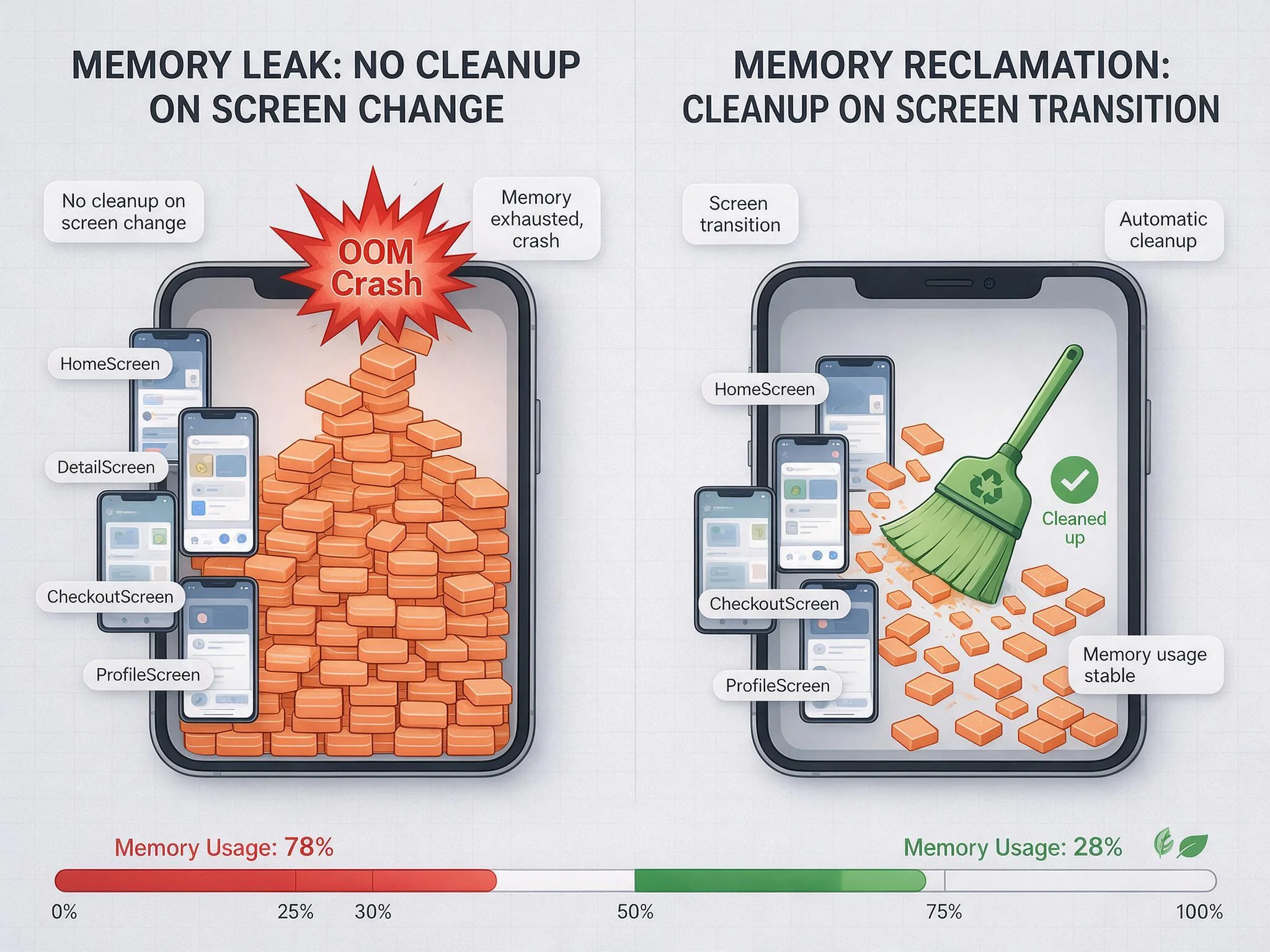
On iOS, preventing WKUserContentController retain cycles requires wrapping the WKScriptMessageHandler in a weak proxy object so that deinit can fire deterministically when the owning view controller leaves the navigation stack. During teardown, the wrapper must explicitly unregister all script message handlers (mraid, omid, sharc), halt active media decoders, load about:blank to purge the DOM tree and JavaScript heap inside the WebContent process, and nil out all delegates before the view reference is dropped:
import UIKit
import WebKit

final class WeakScriptMessageHandler: NSObject, WKScriptMessageHandler {
    weak var delegate: WKScriptMessageHandler?

    init(delegate: WKScriptMessageHandler) {
        self.delegate = delegate
        super.init()
    }

    func userContentController(
        _ userContentController: WKUserContentController,
        didReceive message: WKScriptMessage
    ) {
        delegate?.userContentController(userContentController, didReceive: message)
    }
}

final class SafeAdContainerView: UIView, WKScriptMessageHandler, WKNavigationDelegate {
    private var webView: WKWebView?
    private let bridgeChannels = ["mraidBridge", "sharcBridge", "omidBridge"]

    func initializeAdWebView(sharedProcessPool: WKProcessPool) {
        let config = WKWebViewConfiguration()
        config.processPool = sharedProcessPool
        config.allowsInlineMediaPlayback = true
        config.suppressesIncrementalRendering = true

        let contentController = WKUserContentController()
        let weakProxy = WeakScriptMessageHandler(delegate: self)
        for channel in bridgeChannels {
            contentController.add(weakProxy, name: channel)
        }
        config.userContentController = contentController

        let wv = WKWebView(frame: bounds, configuration: config)
        wv.navigationDelegate = self
        addSubview(wv)
        self.webView = wv
    }

    func userContentController(
        _ userContentController: WKUserContentController,
        didReceive message: WKScriptMessage
    ) {
        // Process MRAID 3.0 or SHARC 1.0 lifecycle payloads
    }

    func webViewWebContentProcessDidTerminate(_ webView: WKWebView) {
        // Recover gracefully if iOS Jetsam kills the isolated WebContent process
        destroyAdWebView()
    }

    func destroyAdWebView() {
        guard let wv = webView else { return }

        wv.stopLoading()
        if #available(iOS 14.5, *) {
            wv.closeAllMediaPresentations { }
        }

        let controller = wv.configuration.userContentController
        for channel in bridgeChannels {
            controller.removeScriptMessageHandler(forName: channel)
        }
        controller.removeAllUserScripts()

        wv.navigationDelegate = nil
        wv.uiDelegate = nil
        wv.scrollView.delegate = nil

        // Flush DOM and release WebGL/Canvas buffers in WebContent daemon
        wv.loadHTMLString("", baseURL: nil)
        wv.removeFromSuperview()
        self.webView = nil
    }

    deinit {
        destroyAdWebView()
    }
}
On Android, the sequence of operations inside Activity.onDestroy() or Fragment.onDestroyView() is equally critical. Calling webView.destroy() while the WebView is still attached to a parent ViewGroup throws internal warnings and can leak the Activity Context via accessibility managers and input method services. Furthermore, instantiating the WebView with the Application context (or a mutable MutableContextWrapper) rather than a hard-coded Activity reference prevents long-lived Chromium singleton hooks from pinning the entire Activity hierarchy in the JVM heap when a configuration change or screen transition occurs. Integrating a lightweight mobile ad SDK that automates this exact teardown sequence eliminates the most common vector of client-side memory leaks:
package com.skyboosts.ads.render

import android.content.ComponentCallbacks2
import android.content.Context
import android.content.MutableContextWrapper
import android.view.ViewGroup
import android.webkit.WebView

class ManagedAdWebViewHolder(appContext: Context) {
    private val contextWrapper = MutableContextWrapper(appContext.applicationContext)
    private var webView: WebView? = WebView(contextWrapper)

    fun attachToActivity(activityContext: Context, container: ViewGroup) {
        contextWrapper.baseContext = activityContext
        webView?.let { wv ->
            (wv.parent as? ViewGroup)?.removeView(wv)
            container.addView(wv)
        }
    }

    fun handleTrimMemory(level: Int) {
        if (level >= ComponentCallbacks2.TRIM_MEMORY_RUNNING_LOW) {
            webView?.clearCache(false)
            webView?.freeMemory()
        }
    }

    fun destroyDeterministically() {
        val wv = webView ?: return
        webView = null

        // Rebind to Application context to sever Activity reference immediately
        contextWrapper.baseContext = contextWrapper.baseContext.applicationContext

        (wv.parent as? ViewGroup)?.removeView(wv)
        wv.stopLoading()
        wv.onPause()

        wv.removeJavascriptInterface("mraidBridge")
        wv.removeJavascriptInterface("sharcBridge")
        wv.webChromeClient = null
        wv.webViewClient = android.webkit.WebViewClient()

        // Clear DOM, V8 timers, and active media pipelines before native destruction
        wv.loadUrl("about:blank")
        wv.clearHistory()
        wv.removeAllViews()
        wv.destroy()
    }
}
Restricting Heavy Bitrates and Uncompressed DOM Assets via OpenRTB maxbitrate and battr
Client-side lifecycle hygiene is necessary, but it cannot prevent an immediate OOM spike if a DSP returns a 25 MB uncompressed playable ad or a 4K inline video stream to a low-tier Android device running with only 180 MB of available heap. True resilience requires linking device-level memory telemetry directly to server-side supply path controls via OpenRTB 2.6 bid request shaping.
Before dispatching an ad request, the mobile SDK inspects the device's physical RAM capacity (ActivityManager.MemoryInfo.totalMem on Android and ProcessInfo.processInfo.physicalMemory on iOS), alongside real-time available heap and thermal state (ProcessInfo.ThermalState). When a device falls into a constrained tier (for example, less than 3 GB of total system RAM, or when the OS broadcasts a TRIM_MEMORY_RUNNING_LOW flag), our unified SSP and monetization platform dynamically rewrites the outgoing OpenRTB 2.6 Imp object to filter out memory-intensive demand before the auction clears.
Specifically, the SSP enforces four protocol-level controls inside the bid request:
- Bitrate Capping (
imp.video.maxbitrate): Restricts video and VAST-inside-banner responses to a safe ceiling (such as 800 to 1200 kbps on low-RAM devices), preventing hardware decoder buffer exhaustion and massiveMediaCodecallocations. - Creative Attribute Blocking (
imp.banner.battrandimp.video.battr): Populates the IAB creative attribute blocklist to exclude auto-expanding units (attribute12), high-overhead user-interactive playables (attribute13) when available heap is critical, and Adobe Flash or legacy heavy containers. - API Framework Filtering (
imp.banner.api): On severely memory-constrained devices or during active gameplay scenes where the host application already consumes 80% of its memory budget, the SSP removes rich media API declarations (5for MRAID 2.0,6for MRAID 3.0) from theapiarray, leaving only OMID-1 (7) so DSPs return lightweight static or standard HTML5 display creatives instead of heavy interactive bundles. - Render Weight Extensions (
imp.ext.max_dom_weight_kb): Communicates strict payload byte limits to participating DSP bidders and our internal creative proxy scanner, rejecting adm payloads that exceed safe DOM and inline base64 asset thresholds.
{
  "id": "req-8849201-mem-constrained",
  "imp": [
    {
      "id": "1",
      "instl": 1,
      "banner": {
        "w": 320,
        "h": 480,
        "pos": 7,
        "battr": [1, 2, 9, 12, 13, 14],
        "api": [6, 7],
        "ext": {
          "max_payload_kb": 1536,
          "disallow_webgl": 1
        }
      },
      "video": {
        "mimes": ["video/mp4", "video/webm"],
        "minduration": 5,
        "maxduration": 30,
        "protocols": [7, 8, 11, 12],
        "w": 320,
        "h": 480,
        "minbitrate": 300,
        "maxbitrate": 1100,
        "battr": [1, 2, 13],
        "api": [6, 7]
      },
      "bidfloor": 4.25,
      "bidfloorcur": "USD"
    }
  ],
  "device": {
    "ua": "Mozilla/5.0 (Linux; Android 13; SM-A145R) AppleWebKit/537.36 (KHTML, like Gecko) Version/4.0 Chrome/122.0.6261.119 Mobile Safari/537.36",
    "os": "Android",
    "osv": "13",
    "make": "Samsung",
    "model": "SM-A145R",
    "ext": {
      "ram_total_mb": 3072,
      "ram_avail_mb": 210,
      "memory_pressure_state": "moderate"
    }
  },
  "tmax": 320
}
By conditioning the OpenRTB request on real-time hardware telemetry, publishers avoid a binary choice between disabling rich media globally (which depresses overall yield) and serving unconstrained playables to every device (which spikes crash rates on budget handsets). High-memory flagship devices continue receiving full-bitrate video and WebGL playables, while memory-constrained devices clear high-fill, lightweight creatives without risking process termination.
Sandboxing Rich Media: MRAID 3.0 vs. IAB SHARC 1.0 (Safe Ad Container)
Even with strict native lifecycle teardown and OpenRTB payload filtering, the architectural design of the container API itself dictates how effectively an ad SDK can isolate and recover from rogue creative scripts. For over a decade, the mobile industry has relied on the Mobile Rich Media Ad Interface Definitions (MRAID) specification. Specifically, MRAID 3.0 standardizes rich media ad interactions in mobile apps, including viewability exposure checks, audibility volume monitoring, pre-fetch readiness states, and standardized close button requirements.
From a memory and CPU management standpoint, MRAID 3.0 introduced several vital improvements over MRAID 2.0:
- Event-Driven Exposure Checks (
exposureChange): In MRAID 2.0, creatives routinely spun up aggressivesetIntervalloops callingmraid.isViewable()every 50 milliseconds, creating constant JavaScript-to-native bridge traffic and preventing garbage collection of transient state objects. MRAID 3.0 replaced this polling anti-pattern with the host-pushedexposureChangeevent, passing the exposed percentage and visible rectangle only when layout geometry actually changes. - Host-Driven Audibility Monitoring (
audioVolumeChange): Eliminates custom creative polling scripts that attempt to probe audio contexts continuously to determine hardware volume levels. - Pre-Fetch Readiness and Explicit Unloading (
mraid.unload()): MRAID 3.0 separates webview pre-caching from display rendering and introduces themraid.unload()method. If a creative encounters an internal asset load failure, WebGL context loss, or buffer allocation error during pre-fetch or active display, the creative can invokemraid.unload()to instruct the host SDK to immediately tear down the WebView container, release its memory footprint, and collapse or backfill the slot before the user experiences UI jank or a crash.
Despite these advancements, MRAID 3.0 carries a fundamental structural limitation: the mraid.js bridge and the third-party ad creative execute inside the same top-level DOM context within the WebView. Because the creative shares the global window object with the native bridge hooks, poorly written or malicious third-party scripts can overwrite prototype methods, attach global event listeners that block garbage collection, or freeze the main renderer thread with synchronous XHR calls and runaway DOM mutations.
To solve this lack of isolation across modern rendering environments, the IAB Tech Lab standards working group introduced the Safe Ad Container (SHARC v1.0) standard to provide a unified, secure cross-environment iframe API for interactive ads across mobile app, web, and HTML environments, succeeding legacy SafeFrames and MRAID.
| Architectural Dimension | MRAID 3.0 Execution Model | IAB SHARC 1.0 (Safe Ad Container) |
|---|---|---|
| DOM & Execution Isolation | Shared global window context; creative code and mraid.js execute in the same top-level frame. |
Cross-origin sandboxed <iframe>; creative runs isolated from the host bridge and top-level DOM. |
| Native Bridge Communication | Direct invocation of injected JS-to-Native objects (webkit.messageHandlers or @JavascriptInterface). |
Asynchronous, structured postMessage API mediated by the host container controller. |
| Memory & Sub-Frame Recovery | Requires tearing down and recreating the entire native WKWebView / WebView instance. |
Host container can drop and garbage-collect the sandboxed child <iframe> without destroying the outer WebView shell. |
| Cross-Environment Portability | Mobile in-app WebViews only; incompatible with standard mobile web SafeFrames. | Unified API surface across in-app WebViews, mobile web, desktop web, and HTML-capable CTV platforms. |
Under the SHARC 1.0 architecture, the mobile SDK initializes a lightweight, trusted host HTML shell inside the WebView and renders the third-party creative markup inside a sandboxed, cross-origin <iframe> (sandbox="allow-scripts allow-popups allow-popups-to-escape-sandbox"). The creative cannot access the parent window, cannot directly invoke native @JavascriptInterface or WKScriptMessageHandler bridges, and cannot mutate the host DOM. All requests for viewport expansion, resize operations, viewability telemetry, and lifecycle transitions travel as structured, asynchronous JSON messages over the SHARC message bus.
For mobile engineering and AdOps teams, SHARC 1.0 unlocks a major operational advantage in memory management: pooled WebView recycling. Because a MRAID 3.0 creative contaminates the top-level global scope of the WebView, reusing a single WebView instance across multiple ad impressions risks state leakage, orphaned global variables, and retained closures from previous advertisers. With SHARC 1.0, the top-level WebView remains completely clean. When an ad refresh occurs or an interstitial closes, the host container simply unmounts the sandboxed child <iframe>, revokes its message port, and triggers garbage collection on the isolated frame context while keeping the warm outer WebView process alive.
To eliminate WebView OOM crashes without sacrificing rich media yield, mobile publishers should audit their ad stack against three concrete engineering benchmarks:
- Verify via Xcode Instruments (
AllocationsandLeaks) and Android Studio Profiler that zeroWKWebVieworandroid.webkit.WebViewinstances survive in memory 5 seconds after their hostUIViewControllerorActivityis dismissed. - Implement
mraid.unload()listeners andwebViewWebContentProcessDidTerminaterecovery handlers in the client mediation layer so that aborted creatives release their native views immediately. - Partner with an SSP architecture that pairs SHARC 1.0 and MRAID 3.0 container sandboxing with real-time OpenRTB
maxbitrateandbattrrequest shaping, ensuring that every creative served matches the physical memory headroom of the target device.