
Mitigating Invalid Traffic (IVT) in CTV: SSAI Proxy Filtering and IP Data Center Exclusions
When a Server-Side Ad Insertion (SSAI) stitcher dispatches VAST 4.3 impression beacons or initiates OpenRTB 2.6 bid requests from an unconfigured cloud

When a Server-Side Ad Insertion (SSAI) stitcher dispatches VAST 4.3 impression beacons or initiates OpenRTB 2.6 bid requests from an unconfigured cloud compute cluster without preserving client-origin metadata, downstream verification engines classify 100% of that inventory as data-center bot traffic. In Connected TV (CTV) environments, the decoupling of media stream playback from client-side ad execution introduces a fundamental telemetry problem. Because the SSAI manifest manipulator acts as an intermediate proxy between the physical living room television and the programmatic supply chain, every HTTP request originates from a commercial cloud Autonomous System Number (ASN) rather than a residential Internet Service Provider (ISP).
If the SSAI proxy fails to extract, sanitize, and forward the household IP address and hardware-specific User-Agent string across every hop of the auction and VAST tracking lifecycle, demand-side platforms (DSPs) and independent verification providers observe thousands of distinct device identifiers (ifa) resolving to a single data-center subnet. The immediate result is automated queries-per-second (QPS) throttling, aggressive bid shading, and post-auction financial clawbacks that erode publisher yield.
Operating a high-fill CTV monetization platform requires deterministic engineering controls at both the SSAI proxy layer and the supply-side platform (SSP) ingestion edge. By enforcing strict HTTP header forwarding protocols, validating OpenRTB 2.6 payload structures against registered SSAI IP allowlists, and implementing sub-millisecond pre-bid exclusions for non-human traffic, AdOps and streaming engineering teams can eliminate false-positive invalid traffic flags while blocking true programmatic fraud at the perimeter.
General Invalid Traffic (GIVT) vs. Sophisticated Invalid Traffic (SIVT) in Connected TV
The Media Rating Council (MRC) and the IAB Tech Lab bifurcate invalid traffic into two distinct operational tiers: General Invalid Traffic (GIVT) and Sophisticated Invalid Traffic (SIVT). In CTV architectures, distinguishing between these two categories determines whether an impression is dropped synchronously at the pre-bid edge via deterministic lookup tables or flagged asynchronously through multi-signal behavioral heuristics.
GIVT consists of routine, non-malicious, or easily identifiable non-human traffic that can be isolated through standard parameter checks. In an OTT streaming environment, GIVT encompasses automated quality assurance probes, synthetic uptime monitors querying HLS (.m3u8) or MPEG-DASH (.mpd) master manifests, known search engine crawlers, and traffic originating from public cloud data centers (such as unallowlisted AWS, Google Cloud Platform, or Microsoft Azure IP ranges) that lack valid SSAI proxy signaling. To standardize industry defenses, the IAB Tech Lab technical standards repository provides foundational filtration resources; specifically, IAB Tech Lab maintains the industry-standard Spiders and Bots list (updated April 2024) and the CTV Programmatic Guide (updated December 2025) to filter automated crawlers, data-center traffic, and misconfigured SSAI proxy headers from billable impression counts.
SIVT, by contrast, represents malicious traffic engineered specifically to evade parameter-based filters and siphon ad spend through human mimicry or protocol manipulation. Within CTV ecosystems, SIVT manifests across four primary attack vectors:
- Server-Side Emulation and Replay Attacks: Fraudulent operations spin up headless Android Open Source Project (AOSP) instances inside residential proxy networks, forging device make, model, and OS parameters (
device.make,device.model,device.os) to mimic high-CPM hardware such as Apple TV (tvOS), Roku, or Samsung Tizen devices. - Compromised Residential Proxy Networks: Bad actors route synthetic VAST tracking requests through malware-infected smart home devices and residential routers. Because the resulting traffic exits from legitimate consumer ISPs (such as Comcast, Charter, or Verizon Fios), it bypasses basic ASN data-center exclusions.
- App and Bundle Spoofing: Unauthorized applications or server-side scripts inject the
app.bundleandapp.storeurlvalues of tier-1 Free Ad-Supported Streaming TV (FAST) channels into fabricated OpenRTB requests to arbitrage premium video demand. - Disconnected Playback Loops: Legitimate CTV applications continue requesting and rendering stitched video ad pods for hours or days after the physical television screen has been powered off via HDMI Consumer Electronics Control (CEC) state disconnects.
Because SIVT vectors deliberately populate fields that pass superficial schema validation, mitigating them requires correlating network-level provenance with cryptographic app identity and session-level telemetry before a single bid request reaches the exchange auction.
Why Unconfigured SSAI Servers Trigger False-Positive SIVT Flags
Unlike client-side VAST execution in web browsers or mobile apps, where the end-user device resolves the VAST XML tag and fires HTTP tracking pixels directly from a household IP address, Server-Side Ad Insertion centralizes ad resolution inside a cloud-hosted stitcher. When a viewer watching a linear FAST stream hits an ad break marker (#EXT-X-CUE-OUT in HLS), the SSAI server intercepts the manifest request, constructs an OpenRTB 2.6 bid request (or queries a primary ad server such as Google Ad Manager 360), transcodes the winning mezzanine video creative into adaptive bitrate segments, and stitches those segments directly into the viewer's media playlist.
As the viewer's CTV device requests successive .ts or .m4s video segments from the CDN, the SSAI server calculates playback progression and fires the corresponding VAST 4.3 tracking beacons (Impression, start, firstQuartile, midpoint, thirdQuartile, complete) on behalf of the client device.
If the SSAI cluster is deployed without custom header injection and proxy registration, every outbound VAST beacon carries the network footprint of the SSAI server itself:
- Source IP Concentration: All impression and quartile beacons originate from a small pool of static NAT gateway IPs belonging to a commercial cloud provider ASN.
- Runtime User-Agent Strings: The HTTP client library inside the SSAI service sends its default runtime signature (for example,
Go-http-client/2.0,Apache-HttpClient/5.2, orpython-requests/2.31.0) rather than the physical television's User-Agent string. - Broken Session Continuity: When third-party verification wrappers embedded in the VAST XML inspect the incoming HTTP socket, they detect a mismatch between the device parameters declared inside the OpenRTB bid stream and the server parameters executing the VAST impression.
To an automated verification engine such as HUMAN or Pixalate, an unconfigured SSAI server is indistinguishable from a data-center botnet running a VAST replay script. Maintaining institutional-grade IVT filtering and brand safety requires configuring the SSAI architecture to act as a transparent telemetry relay.
Properly Forwarding X-Forwarded-For and Device User-Agent Headers
To prevent false-positive SIVT classification during server-side beacon execution, the SSAI stitcher must capture the original client HTTP connection attributes at the point of manifest ingestion and attach them as explicit forwarding headers on every outbound request to ad servers, SSPs, and VAST verification trackers.
The primary mechanism for preserving client network provenance is the X-Forwarded-For (XFF) HTTP header, paired with dedicated device User-Agent forwarding headers (X-Device-User-Agent or direct replacement of the User-Agent header). However, multi-hop CDN architectures introduce a critical parsing hazard. When a Roku or LG webOS television requests a stream playlist, the request typically traverses a regional CDN edge node and an API load balancer before reaching the SSAI manifest controller. Each intermediate proxy appends the preceding hop's IP address to the X-Forwarded-For string:
X-Forwarded-For: 73.162.45.112, 172.68.14.22, 10.240.0.15
In this comma-delimited list, the leftmost public IP address (73.162.45.112) represents the household CTV device, while subsequent addresses represent CDN edge nodes and internal VPC load balancers. If an attacker injects a spoofed X-Forwarded-For header from the client side prior to hitting the CDN, naive leftmost parsing will ingest the forged IP. Therefore, the CDN perimeter must be configured to strip untrusted client-supplied XFF headers upon ingress, or the SSAI origin must parse the XFF chain from right to left, stopping at the first IP address outside the publisher's trusted CDN and internal VPC CIDR ranges.
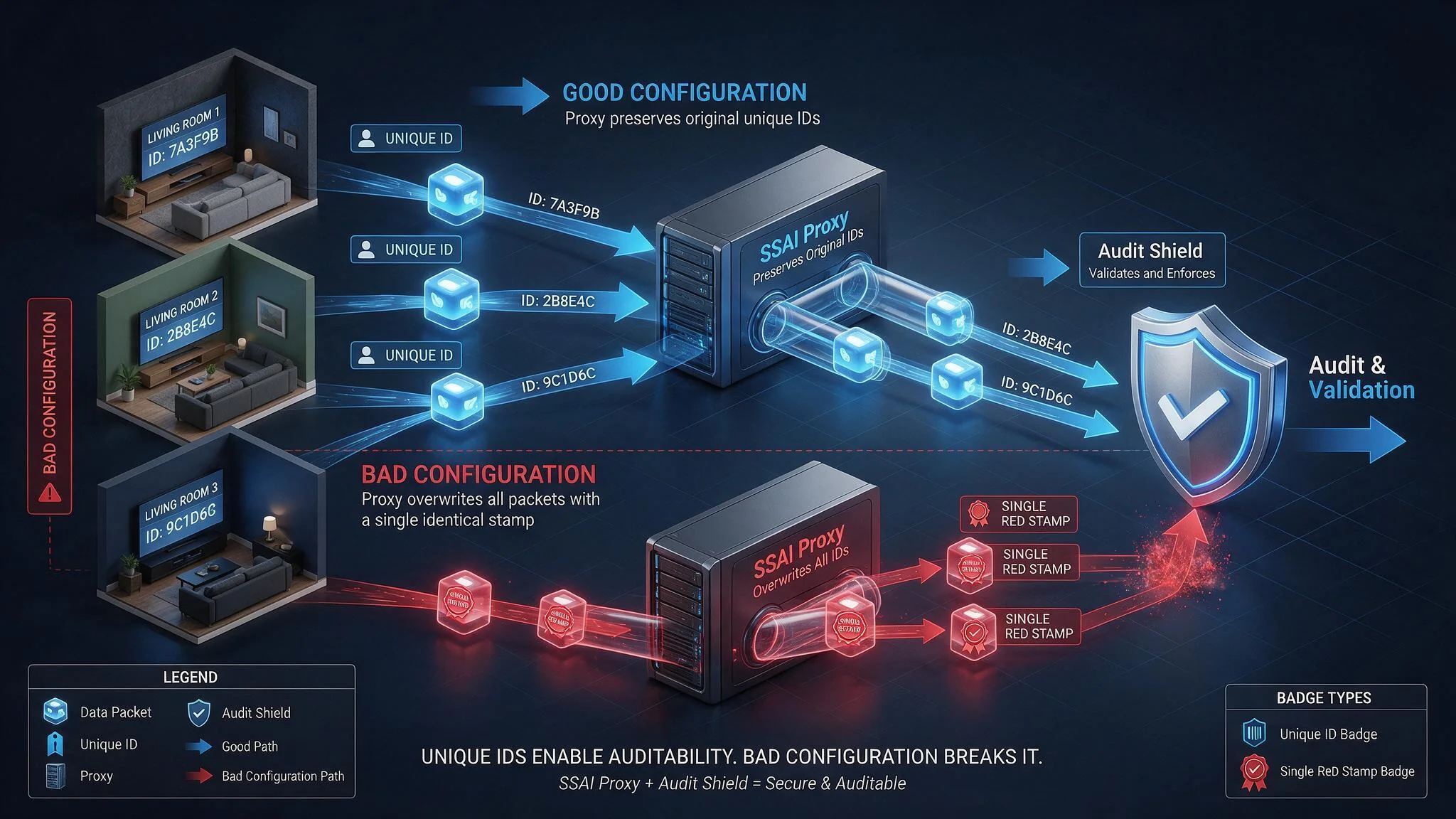
Once the true residential IP and hardware User-Agent are isolated at the manifest layer, the SSAI beacon dispatcher must inject them into all outbound VAST tracking calls. Below is a production Go implementation demonstrating how an SSAI tracking worker sanitizes the proxy chain and dispatches a VAST 4.3 impression beacon with compliant headers:
package ssaibeacon

import (
	"context"
	"net"
	"net/http"
	"strings"
	"time"
)

type DeviceTelemetry struct {
	ClientIP        string
	DeviceUserAgent string
	SessionID       string
}

func ExtractTrustedClientIP(xffHeader string, trustedProxies []*net.IPNet) string {
	ips := strings.Split(xffHeader, ",")
	for i := len(ips) - 1; i >= 0; i-- {
		candidate := strings.TrimSpace(ips[i])
		parsedIP := net.ParseIP(candidate)
		if parsedIP == nil {
			continue
		}
		isTrustedProxy := false
		for _, cidr := range trustedProxies {
			if cidr.Contains(parsedIP) {
				isTrustedProxy = true
				break
			}
		}
		if !isTrustedProxy {
			return candidate
		}
	}
	return ""
}

func FireVASTBeacon(ctx context.Context, client *http.Client, beaconURL string, tel DeviceTelemetry) error {
	req, err := http.NewRequestWithContext(ctx, http.MethodGet, beaconURL, nil)
	if err != nil {
		return err
	}

	// Preserve client identity across SSAI proxy boundary
	req.Header.Set("User-Agent", tel.DeviceUserAgent)
	req.Header.Set("X-Device-User-Agent", tel.DeviceUserAgent)
	req.Header.Set("X-Forwarded-For", tel.ClientIP)
	req.Header.Set("X-Real-IP", tel.ClientIP)
	req.Header.Set("Accept", "*/*")

	resp, err := client.Do(req)
	if err != nil {
		return err
	}
	defer resp.Body.Close()
	return nil
}
By overriding the default Go HTTP client User-Agent with the exact hardware string captured during manifest initiation (for example, Roku/DVP-12.5 (12.5.0.4178-C2) or Mozilla/5.0 (SMART-TV; LINUX; Tizen 7.0) AppleWebKit/537.36), the SSAI server ensures that downstream verification trackers reconcile the HTTP beacon against the original bid request.
The Role of the OpenRTB source and device.ip Fields
Before VAST beacon execution ever occurs, the initial OpenRTB 2.6 bid request must accurately communicate both the viewer's household telemetry and the presence of an intermediate SSAI server. If an SSP receives an OpenRTB POST request from a data-center TCP socket without explicit proxy declarations, its pre-bid IVT firewall may reject the request as an unauthorized server-side injection.
In a compliant OpenRTB 2.6 CTV payload, the device.ip (or device.ipv6) attribute must exclusively contain the end-user's residential IP address extracted from the sanitized X-Forwarded-For header. Under no circumstances should the SSAI server populate device.ip with its own cloud compute IP address. Concurrently, device.ua must contain the physical CTV hardware User-Agent, and device.ifa must carry the unhashed, platform-standard advertising ID (such as RIDA on Roku, TIFA on Samsung Tizen, or IDFA on Apple tvOS), accompanied by the corresponding device.lmt (Limit Ad Tracking) integer flag and ext.ifa_type taxonomy string.
To establish complete supply path transparency, the OpenRTB source object must declare the schain (SupplyChain) object alongside server-side ad insertion provenance. When the SSP receives the bid request, its ingestion gateway inspects the TCP peer IP of the caller (the SSAI server's egress IP) and validates it against an internal registry of authorized SSAI proxy CIDR blocks while evaluating device.ip against residential ISP geolocation and fraud databases.
{
  "id": "80ce30c53c16e0b3321199a01b8972c9",
  "imp": [
    {
      "id": "1",
      "video": {
        "mimes": ["video/mp4", "application/x-mpegURL"],
        "minduration": 15,
        "maxduration": 30,
        "protocols": [7, 8, 11, 12],
        "w": 1920,
        "h": 1080,
        "startdelay": 0,
        "plcmt": 1,
        "linearity": 1,
        "sequence": 1,
        "maxseq": 4,
        "podid": "pod_midroll_02",
        "podseq": 1
      },
      "bidfloor": 14.50,
      "bidfloorcur": "USD"
    }
  ],
  "app": {
    "id": "49102",
    "name": "Apex Stream News FAST",
    "bundle": "tv.apexstream.news",
    "storeurl": "https://channelstore.roku.com/details/49102/apex-stream-news",
    "publisher": {
      "id": "pub_99182"
    }
  },
  "device": {
    "ua": "Roku/DVP-12.5 (12.5.0.4178-C2)",
    "ip": "73.162.45.112",
    "make": "Roku",
    "model": "4802X",
    "os": "Roku",
    "osv": "12.5",
    "devicetype": 3,
    "ifa": "8a910b22-4c15-55a1-9b81-001928374655",
    "lmt": 0,
    "ext": {
      "ifa_type": "rida",
      "session_id": "sess_f99102a8b"
    }
  },
  "source": {
    "fd": 1,
    "tid": "a1b2c3d4-e5f6-7890-abcd-ef1234567890",
    "schain": {
      "complete": 1,
      "ver": "1.0",
      "nodes": [
        {
          "asi": "skyboosts.com",
          "sid": "pub_99182",
          "hp": 1
        }
      ]
    },
    "ext": {
      "ssai": 1
    }
  },
  "tmax": 350
}
Setting device.devicetype to 3 (Connected TV) alongside the source.ext.ssai indicator allows participating DSPs to distinguish legitimate server-stitched inventory from anomalous data-center traffic, preserving bid density across the auction.
Detecting App Spoofing and Continuous Playback Loops on CTV Devices
While proper SSAI header forwarding resolves false-positive GIVT and SIVT flags, sell-side engineering teams must simultaneously harden their ingestion pipelines against active SIVT exploits targeting CTV devices: specifically, cross-platform bundle spoofing and continuous background playback loops.
App spoofing occurs when unauthorized applications (often running on uncertified, sideloaded Android TV boxes) or server-side botnets hardcode the app.bundle ID of a brand-safe television network into outgoing ad requests. Because standard OpenRTB fields are transmitted as plain text JSON, relying solely on app.bundle and app-ads.txt file checks is insufficient; an attacker can easily read a publisher's public app-ads.txt file and forge the exact source.schain and publisher ID entries authorized in that file.
Defeating CTV app spoofing requires three layers of telemetry verification:
- Cryptographic Programmatic Access Library (PAL) Signals: Integrating the Google PAL SDK or OM SDK for CTV generates an encrypted nonce attached to the ad request. This cryptographic payload validates the runtime integrity of the client application environment and confirms that the request originated from an authentic hardware build rather than a server-side script.
- OS-to-Store-ID Cross-Validation: Every CTV operating system enforces a strict naming convention for application bundles. Roku channel IDs are numeric strings (for example,
49102), Samsung Tizen uses alphanumeric app IDs (for example,3201907018807), and Apple tvOS / Android TV use reverse-DNS strings (com.publisher.app) paired with numeric App Store IDs. If an incoming bid request declaresdevice.os: "Roku"and a Roku User-Agent string, but passes an Android reverse-DNS string inapp.bundle, our ingestion engine immediately terminates the auction and logs an SIVT spoofing event. - Network ASN and Geolocation Velocity Checks: If a single
device.ifagenerates bid requests across multiple geographically dispersed residential IPs within an impossible physical travel window, or exhibits uniform inter-request intervals characteristic of a cron job, the device ID is quarantined across the exchange.
Continuous playback loops represent a different class of CTV invalid traffic. Many consumers connect external streaming sticks or set-top boxes to a television's HDMI port while powering the streaming stick via a wall outlet rather than the TV's switched USB port. When the user turns off the television screen with the TV remote, the streaming stick remains powered on and continues playing the FAST channel 24 hours a day.
To eliminate unviewed continuous playback impressions under our trust and compliance standards, CTV applications and SSAI controllers must monitor both hardware display states and session duration thresholds. On client platforms that expose HDMI CEC or HdmiControlManager APIs, the player application should listen for display standby events and pause playback immediately when the television panel turns off. Where hardware HDMI state APIs are restricted by the OS, the SSAI manifest stitcher and SSP enforce a strict session duration ceiling: if a single device.ifa and device.ip pair continuously requests ad pods for more than 4 consecutive hours without a remote control interaction event (such as a channel change, pause, or volume adjustment signal), the platform suspends ad monetization on that stream until an active user heartbeat is recorded.
Pre-Bid Filtering Using the IAB Spiders and Bots List
The final line of defense against CTV invalid traffic is synchronous pre-bid filtration at the SSP edge gateway. Filtering invalid traffic post-auction wastes outbound QPS allocations with DSP partners, inflates cloud egress bandwidth costs, and exposes the exchange to billing reconciliation discrepancies.
To execute pre-bid filtration within a sub-millisecond latency budget (well beneath the 350ms to 500ms CTV auction timeout curve), the ingestion edge must evaluate every incoming HTTP request against two in-memory data structures before serializing the OpenRTB bid stream:
- In-Memory Patricia Trie for CIDR Exclusions: All known public cloud data-center IPv4 and IPv6 CIDR blocks, VPN exit nodes, Tor relays, and unverified proxy ranges are compiled into a memory-mapped radix tree (patricia trie). When an SSAI request arrives, the edge gateway checks the caller's TCP socket IP against an explicit allowlist of verified SSAI stitcher CIDR blocks. It then evaluates the extracted
device.ipagainst the data-center exclusion trie inO(k)time (wherekis the prefix length, maximum 32 operations for IPv4 or 128 for IPv6). Ifdevice.ipresolves to a data-center ASN, the request is dropped with an HTTP204 No Contentresponse prior to auction instantiation. - Aho-Corasick Automaton for User-Agent Filtering: The IAB Tech Lab Spiders and Bots list contains hundreds of substring patterns identifying automated crawlers, headless browsers, and server HTTP libraries, paired with explicit exception strings for legitimate browser and device signatures. Compiling these patterns into a deterministic finite automaton using the Aho-Corasick algorithm allows the SSP gateway to scan
device.uaagainst the entire exclusion and exception dictionary in a single linear pass (O(n)relative to User-Agent string length).
For engineering and AdOps teams managing CTV supply, the operational mandate is clear: audit every SSAI stitcher deployment to verify that sanitized household client IPs and hardware User-Agent strings are forwarded on both OpenRTB bid requests and VAST 4.3 tracking beacons, register all SSAI egress NAT IPs with your SSP partners, and enforce deterministic CIDR and IAB bot list exclusions at the pre-bid edge. By uniting transparent SSAI proxy telemetry with rigorous pre-bid network filtration, publishers protect their inventory from false-positive clawbacks, maximize DSP bid density, and secure predictable Net-30 and Net-60 revenue streams across their entire Connected TV portfolio.