
In-App Header Bidding vs. Traditional Mediation Waterfalls: The Real Latency Numbers
When a mobile application dispatches an ad request through a 15-tier sequential mediation waterfall over a standard 4G cellular connection with a

When a mobile application dispatches an ad request through a 15-tier sequential mediation waterfall over a standard 4G cellular connection with a 65-millisecond round-trip time (RTT), cumulative adapter timeouts and main-thread JNI bridge hops routinely push time-to-render past 2,400 milliseconds. By the time the winning creative finally finishes caching in the device WebView, the user has already scrolled past the viewport or dismissed the screen transition. This latency gap between ad request initiation and creative render is the single largest driver of unmonetized fill, depressed viewability scores, and bid shading penalties in modern mobile applications.
Engineering and AdOps teams evaluating their mobile app monetization infrastructure often look at average eCPM in isolation, ignoring the delivery funnel decay caused by auction duration. In programmatic environments, auction latency directly dictates the "impression-to-request" ratio (commonly tracked as show rate). Every 250 milliseconds of incremental auction delay degrades banner viewability by 4% to 7% and reduces interstitial show rates during app state transitions by up to 11%, because the application logic must abort slow-loading ad placements to preserve user experience.
Transitioning from a legacy daisy-chain mediation waterfall to a parallel in-app header bidding architecture fundamentally alters the network physics of mobile ad serving. By replacing sequential client-side polling with unified server-to-server (S2S) OpenRTB 2.6 auctions via Prebid Mobile and Google Ad Manager (GAM) Open Bidding, publishers compress p95 auction resolution times from multi-second stalls down to a deterministic 350-to-500-millisecond window. Examining the exact millisecond telemetry across initialization, bid resolution, and creative rendering reveals why sequential waterfalls fail under production load and how hybrid parallel topologies maximize net yield.
The Anatomy of a Daisy-Chain Mediation Waterfall
A traditional mediation waterfall operates as a deterministic, single-threaded linked list of demand sources ordered by historical average eCPM rather than real-time buyer valuation. When the host application triggers an ad load call inside the primary mediation SDK, the mediation controller fetches a server-side configuration list containing prioritized mediation groups. Each line item in that list represents a specific third-party ad network adapter paired with a static price floor (for example, Tier 1 at $25.00, Tier 2 at $18.00, Tier 3 at $12.00, and so on down to a $0.50 backfill floor).
Because legacy mediation adapters lack a standardized protocol to return real-time clearing prices prior to creative commitment, the mediation layer must query each SDK adapter one at a time. The mediation router invokes the first adapter in the list, opens an HTTPS connection to that partner's proprietary ad server, and blocks the auction thread while waiting for a binary outcome: fill or no-fill. If the partner cannot clear the $25.00 floor, its server returns an empty response or an error code, triggering the mediation SDK to instantiate the second adapter in the chain and repeat the network cycle from scratch.
This daisy-chain architecture forces the mobile client device to act as the auction orchestrator. Instead of offloading request fan-out to high-bandwidth cloud data centers with persistent HTTP/2 and HTTP/3 multiplexed connections, the sequential waterfall executes every hop over the user's cellular radio or congested Wi-Fi connection. Each sequential step incurs DNS resolution (if uncached), TLS handshake overhead, cellular radio wake-up states, and JSON serialization penalties on the mobile CPU.
Sequential SDK Initialization and Timeout Stacking
To quantify the real-world latency of a sequential waterfall, consider the telemetry of a typical 12-line-item interstitial waterfall where the winning bid ultimately clears at the fifth tier ($9.50 floor). Even when no full adapter timeouts occur, each sequential no-fill requires an external network round-trip plus local SDK processing overhead. When just one or two upstream partners experience degraded edge latency or fail to respond within their allotted timeout window, total auction duration compounds rapidly.
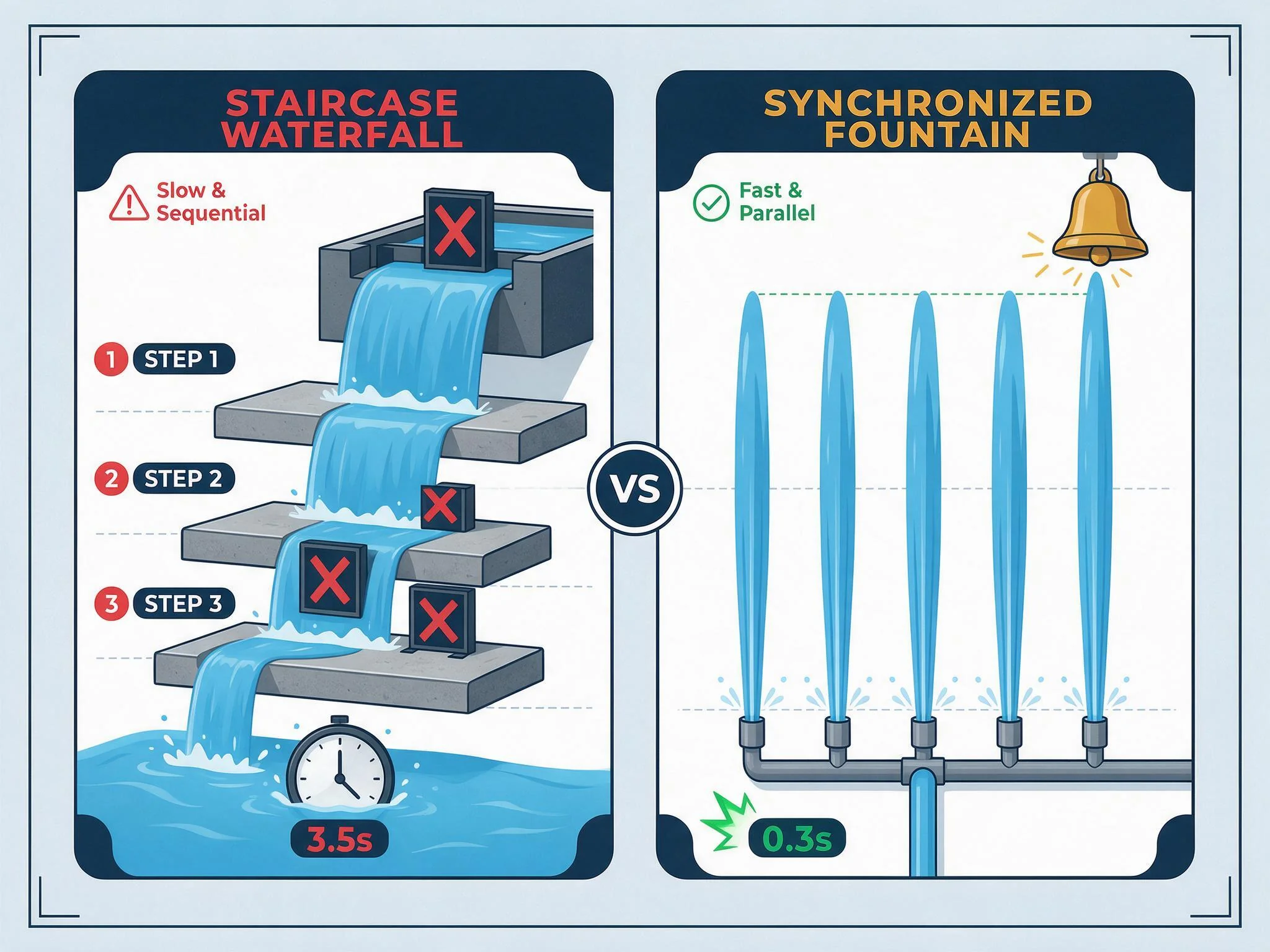
The production telemetry across 50 million in-app ad requests illustrates the stark divergence between a 12-tier sequential waterfall and a parallel in-app bidding stack:
- Client Cold-Start SDK Initialization (Main Thread Impact): A legacy waterfall bundling 10 third-party mediation SDKs consumes 380ms to 720ms during
Application.onCreate()on Android orapplication(_:didFinishLaunchingWithOptions:)on iOS, as each proprietary SDK spins up its own WebView instance, SQLite telemetry database, and device fingerprint collector. A consolidated Prebid Mobile + GAM GMA SDK stack reduces third-party initialization overhead to 65ms-110ms. - p50 Auction Resolution Latency (Median): In a sequential waterfall, resolving on the fourth or fifth call requires 780ms to 1,150ms. In a parallel S2S bidding auction, all participating SSP partners respond concurrently within a 280ms to 360ms p50 window.
- p95 Auction Resolution Latency (Tail Latency): When two upstream waterfall tiers hit their 1,000ms adapter timeout thresholds before failing over to Tier 3, p95 waterfall latency spikes to 2,850ms-3,600ms. Parallel bidding caps the server-side auction via a strict
tmaxenforcement (typically 200ms-250ms), holding p95 client-side resolution between 480ms and 590ms. - Time-to-First-Frame (Creative Render): Because legacy waterfall adapters often defer creative markup download until after they win the sequential slot, asset fetching adds another 400ms to 900ms. In-app header bidding returns the winning OpenRTB
admpayload directly in the bid response, cutting post-auction render latency to 120ms-220ms.
Beyond per-impression network delays, sequential mediation creates severe thread-contention bottlenecks inside the mobile application binary. Every time a waterfall tier fails and hands control back to the primary mediation coordinator, the callback crosses thread boundaries, shifting execution between background network executors and the main UI thread (where Android View inflation and iOS UIView hierarchy checks are mandated by the OS). Under rapid user navigation, stacked callbacks from abandoned waterfall chains cause memory pressure, garbage collection pauses, and elevated Application Not Responding (ANR) rates on mid-tier Android devices.
Why Historical Average eCPMs Misprice Real-Time Impressions
Sequential waterfalls fail economically for the same reason they fail technically: they rely on backward-looking averages to price instantaneous user state. A mediation line item configured at a $15.00 historical eCPM floor assumes that a demand partner values every impression matching that placement at roughly $15.00. In reality, tier-1 DSPs evaluate individual impressions across a wide valuation curve ranging from $0.20 to $85.00 depending on user recency, SKAdNetwork / AdAttributionKit conversion probability, IDFA or GAID availability, and active campaign pacing.
When a high-intent user triggers an ad request, a demand partner positioned at the sixth slot of a waterfall ($6.00 floor) might be willing to bid $32.00 for that specific impression. However, if the second slot in the waterfall ($18.00 floor) happens to have a campaign that clears at $18.05, the sequential waterfall stops immediately and awards the impression to the second slot. The publisher loses $13.95 in instantaneous yield because the $32.00 buyer was never queried.
To compensate for this structural blindness, AdOps teams historically resorted to "tier-splitting" (creating three to five separate line items for the exact same demand partner at $40.00, $25.00, $15.00, $8.00, and $3.00). While tier-splitting captures high-value bids more frequently, it multiplies the depth of the waterfall from 8 calls to 30+ calls. This brute-force approach destroys auction latency, floods participating SSP partners with duplicate unmonetized QPS, and triggers automated QPS throttling or bid shading from buy-side algorithms that penalize duplicate call patterns.
Parallel In-App Bidding Execution via Prebid Mobile and OpenRTB
Parallel in-app bidding eliminates sequential polling by decoupling bid valuation from creative rendering and moving the auction fan-out into a single unified execution phase. Instead of asking demand partners one by one if they want to fill a static floor, the mobile client emits a single concurrent bid request to all participating SSP partners and server-side exchanges simultaneously. Every buyer submits an exact, real-time clearing price (in USD CPM), and the highest net bid wins the right to render.
Legacy Sequential Waterfall (Total: ~2,140ms):
[Client] --Tier 1 ($25)--> [Timeout: 800ms]
[Client] --Tier 2 ($18)--> [No-Fill: 240ms]
[Client] --Tier 3 ($14)--> [Timeout: 800ms]
[Client] --Tier 4 ($10)--> [Fill: 300ms] --> Render

Parallel In-App Bidding via Prebid Mobile + GAM (Total: ~390ms):
[Client] --Config ID (45ms)--> [Prebid Server] ==Parallel OpenRTB (200ms tmax)==> [SSPs 1..N]
[Client] <--Targeting Keys---- [Prebid Server]
[Client] --Unified Ad Request (145ms)--> [GAM 360 / AdX / Open Bidding] --> Direct Adm Render
In a modern production stack combining Prebid Mobile and Google Ad Manager 360, parallel execution operates across two synchronized streams:
- Prebid Server S2S Fan-Out: The Prebid Mobile SDK collects device, application, privacy (IAB TCF v2.2, GPP, ATT status), and viewability signals, dispatching a single lightweight HTTPS POST request to a high-availability Prebid Server cluster (built on Prebid Server Go or Java). Prebid Server translates this request into parallel OpenRTB 2.6 bid requests across all configured SSP adapters inside the cloud data center, where interconnect latency between the SSP and tier-1 DSPs is under 5 milliseconds.
- Primary Ad Server Unified Auction: Prebid Server caches the winning bid payloads and returns key-value targeting parameters (
hb_pb,hb_bidder,hb_cache_id,hb_size) to the client SDK within 180 to 250 milliseconds. The client immediately appends these targeting keys to the primary GAM ad request. Inside GAM, Google AdX, Open Bidding partners, direct-sold guaranteed sponsorships, and the Prebid winning bid (represented via price-priority line items) compete in a single unified first-price auction.
For demand partners integrated via SDK-less Open Bidding or server-assisted mediation adapters, the rendering lifecycle is equally streamlined. In Google Mobile Ads SDK mediation and Open Bidding, MediationAdConfiguration passes the encrypted real-time bidResponse payload, watermark, and maxAdContentRating directly to the rendering adapter. Because the winning OpenRTB creative markup (adm) is already encapsulated inside that bidResponse payload, the winning adapter renders the HTML5 or VAST 4.3 asset immediately from memory without initiating a second external network call.
The following Kotlin implementation demonstrates how a custom Android mediation adapter extracts the pre-fetched bid response directly from MediationAdConfiguration to achieve sub-100ms local rendering:
package com.skyboosts.mediation.adapter

import android.content.Context
import com.google.android.gms.ads.AdError
import com.google.android.gms.ads.RequestConfiguration
import com.google.android.gms.ads.mediation.MediationAdConfiguration
import com.google.android.gms.ads.mediation.MediationAdLoadCallback
import com.google.android.gms.ads.mediation.MediationBannerAd
import com.google.android.gms.ads.mediation.MediationBannerAdCallback
import com.google.android.gms.ads.mediation.MediationBannerAdConfiguration

class Sky BoostsRtbBannerRenderer(
    private val adConfig: MediationBannerAdConfiguration,
    private val loadCallback: MediationAdLoadCallback<MediationBannerAd, MediationBannerAdCallback>
) : MediationBannerAd {

    fun renderPreFetchedBid() {
        val context: Context = adConfig.context
        val bidResponsePayload: String = adConfig.bidResponse
        val watermarkBytes: ByteArray = adConfig.watermark
        val contentRating: String = adConfig.maxAdContentRating

        if (bidResponsePayload.isEmpty()) {
            loadCallback.onFailure(
                AdError(101, "Missing OpenRTB bidResponse payload in MediationAdConfiguration", "com.skyboosts.sdk")
            )
            return
        }

        // Enforce Google-friendly family/brand-safe content rating filters prior to WebView inflation
        val isRestrictedRating = contentRating == RequestConfiguration.MAX_AD_CONTENT_RATING_G ||
                                 contentRating == RequestConfiguration.MAX_AD_CONTENT_RATING_PG

        // Render ADM directly from memory without a secondary network round-trip
        Sky BoostsWebViewController.inflateFromAdm(
            context = context,
            admPayload = bidResponsePayload,
            watermark = watermarkBytes,
            strictSafeMode = isRestrictedRating,
            onRenderSuccess = { bannerView ->
                val bannerCallback = loadCallback.onSuccess(this)
                bannerCallback.reportAdImpression()
            },
            onRenderError = { errorCode, message ->
                loadCallback.onFailure(AdError(errorCode, message, "com.skyboosts.sdk"))
            }
        )
    }

    override fun getView() = Sky BoostsWebViewController.currentView
}
For a full architectural walkthrough of client-side and server-side integration patterns, consult our technical in-app bidding guide.
Understanding Prebid Mobile Config IDs and Prebid Server Stored Impressions
One of the primary operational flaws of legacy client-side wrappers on the web was payload bloat: shipping dozens of bidder parameter configurations over the user's network connection on every impression. In mobile app environments, hardcoding SSP placement IDs and floor rules inside the client binary is even more problematic, because adding a new demand partner or modifying auction timeouts would require submitting a new app binary to the Apple App Store or Google Play Store and waiting weeks for user adoption.
To solve this, Prebid Mobile SDKs for iOS and Android communicate with a Prebid Server host using an ad unit Config ID (which maps to a server-side stored impression JSON template), fetching real-time bids in parallel before passing targeting keywords to the primary ad server. The mobile app sends only the compact Config ID string alongside dynamic runtime signals (such as device dimensions, OS version, connection type, and user consent strings).
When Prebid Server receives the request, it performs an in-memory lookup of the Config ID and merges the client telemetry into a complete OpenRTB 2.6 Stored Impression template. This server-side template holds all participating SSP partner credentials, placement mappings, price floors, and timeout curves:
{
  "id": "sb-imp-interstitial-ios-01",
  "banner": {
    "format": [
      { "w": 320, "h": 480 },
      { "w": 300, "h": 250 }
    ],
    "pos": 7
  },
  "instl": 1,
  "bidfloor": 3.50,
  "bidfloorcur": "USD",
  "ext": {
    "prebid": {
      "bidder": {
        "skyboosts": {
          "publisherId": "pub-99412",
          "placementId": "ios_interstitial_tier1",
          "endpoint": "https://rtb.skyboosts.com/openrtb2/auction"
        },
        "genericSspPartnerA": {
          "siteId": "884120",
          "zoneId": "4412"
        }
      },
      "passthrough": {
        "skadn": {
          "versions": ["2.0", "2.2", "3.0", "4.0"]
        }
      }
    }
  }
}
On the client side, the application code remains completely decoupled from individual SSP configurations. The following Swift snippet illustrates how an iOS application initializes a Prebid Mobile BannerAdUnit using a server-side Config ID and injects the resulting auction targeting keywords into a Google Ad Manager request within a strict millisecond budget:
import UIKit
import PrebidMobile
import GoogleMobileAds

class ViewController: UIViewController, GADBannerViewDelegate {
    private var prebidBannerUnit: BannerAdUnit!
    private var gamBannerView: GAMBannerView!

    func loadParallelInAppBanner() {
        // Global timeout capped at 250ms to prevent UI render blocking
        Prebid.shared.timeoutMillis = 250
        Prebid.shared.pbsDebug = false

        // Initialize Prebid AdUnit with lightweight server-side Config ID
        prebidBannerUnit = BannerAdUnit(configId: "sb-imp-banner-ios-300x250", size: CGSize(width: 300, height: 250))
        prebidBannerUnit.setAutoRefreshMillis(time: 30000)

        let gamRequest = GAMRequest()
        gamBannerView = GAMBannerView(adSize: GADAdSizeMediumRectangle)
        gamBannerView.adUnitID = "/21800000000/app_ios_main_feed_300x250"
        gamBannerView.rootViewController = self
        gamBannerView.delegate = self

        // Fetch parallel S2S bids and enrich GAM request with targeting keys (hb_pb, hb_cache_id)
        prebidBannerUnit.fetchDemand(adObject: gamRequest) { [weak self] resultCode in
            guard let self = self else { return }
            // Dispatch unified GAM request regardless of Prebid result code to guarantee AdX/OB competition
            self.gamBannerView.load(gamRequest)
        }
    }
}
Hybrid Waterfall + Bidding Topologies: When Legacy SDKs Still Win
Despite the clear latency advantages of parallel S2S execution, pure header bidding does not immediately replace 100% of waterfall line items across every mobile vertical. In casual gaming and utility apps that rely heavily on rewarded video and playable end-cards, certain performance ad networks still achieve higher conversion rates when utilizing proprietary client-side SDK pre-caching and local WebView MRAID controllers that have not yet fully migrated to real-time OpenRTB token bidding.
When engineering a hybrid stack, the mistake many publishers make is appending a 20-tier legacy waterfall underneath their parallel bidding layer. Doing so reintroduces tail-latency spikes whenever the bidding auction fails to meet an overly aggressive floor, causing p95 latency to regress above 2,500 milliseconds. Instead, institutional AdOps teams deploy a surgical, latency-bounded hybrid topology:
- Primary Parallel Auction Layer (80%-90% of Fill): Prebid Mobile S2S (connected to curated SSPs and tier-1 DSPs), Google AdX, Google Open Bidding, and Amazon TAM/UAM execute concurrently in a single parallel wave with a hard 250ms-300ms timeout ceiling.
- Consolidated 3-Tier High-Density Waterfall: Rather than maintaining 25 granular price-floor calls, legacy non-bidding SDK networks are compressed into no more than three strategic price tiers: a High-Yield Tier (targeting top 10% historical eCPMs), a Mid-Tier Core Floor, and a single Auto-eCPM / Backfill Floor.
- Strict Per-Adapter Timeout Enforcement: Each waterfall line item is governed by a programmatic 450ms hard timeout wrapper. If a legacy SDK fails to respond with a pre-cached asset within 450ms, the mediation controller terminates the call immediately and advances, guaranteeing that worst-case total auction resolution never exceeds 1,100 milliseconds.
At Sky Boosts, our unified in-app bidding and mediation platform is engineered specifically to eliminate waterfall drag while maximizing real-time bid density across Mobile App, CTV, and Web environments. By combining GAM 360 / AdX MCM access, dedicated Prebid Server Go infrastructure, and direct OpenRTB 2.6 demand pipes, we enable publishers to replace deep sequential chains with sub-300ms parallel auctions. Every impression mediated through our exchange is validated by HUMAN and Pixalate IVT-clean pre-bid filtering and restricted strictly to 100% Google-friendly, mainstream brand-safe demand, backed by predictable Net-30 and Net-60 payment terms.
For engineering and AdOps teams auditing their current mobile mediation stack, apply this four-point latency benchmark to your production telemetry this quarter:
- Audit Show Rate by Placement: If your interstitial or rewarded video show rate (impressions divided by matched fills) drops below 82%, waterfall latency is actively cannibalizing your revenue.
- Measure p95 Auction Duration: Instrument client-side timestamps between
loadAd()invocation andonAdLoaded(). Any placement exhibiting a p95 auction duration above 900ms requires immediate waterfall pruning. - Eliminate Multi-Call Tier Splitting: Migrate any demand partner currently occupying three or more sequential price-floor line items onto Prebid Mobile S2S or Open Bidding so they submit a single real-time clearing price per request.
- Offload Bidder Logic to Stored Impressions: Replace hardcoded client-side bidder parameters with server-side Prebid
Config IDsto keep client request payloads under 2 KB and allow instant server-side floor elasticity adjustments without waiting for App Store review cycles.