
Ad Server vs. SSP vs. Ad Network: Clarifying the Modern Monetization Stack for Digital Publishers
When a client runtime dispatches an ad request via Google Publisher Tag (GPT), the Google Mobile Ads (GMA) Next-Gen SDK, or a Connected TV (CTV) Server-Side

When a client runtime dispatches an ad request via Google Publisher Tag (GPT), the Google Mobile Ads (GMA) Next-Gen SDK, or a Connected TV (CTV) Server-Side Ad Insertion (SSAI) stitcher, that single impression opportunity traverses up to three distinct decisioning layers in under 400 milliseconds: the supply-side platform (SSP) auction tier, the value-add ad network aggregation layer, and the primary ad server's final line-item arbitration engine. Treating these three architectural components as interchangeable vendor categories is one of the most common causes of latency inflation, floor cannibalization, and working-capital friction in digital publishing.
In production environments across Web, Mobile App, and CTV, each component solves a fundamentally different engineering and financial problem. The primary ad server acts as the deterministic system of record for inventory hierarchy, direct-sold commitments, and final impression delivery. The SSP operates as the real-time programmatic exchange fabric, translating publisher supply signals into OpenRTB 2.6 bid requests and executing high-throughput auctions across connected demand-side platforms (DSPs). The modern ad network functions as a yield-multiplying aggregation, demand-curation, and operational management layer that compresses supply paths and stabilizes cash flow.
Architecting a high-yield monetization stack requires separating marketing terminology from actual protocol execution. By mapping the exact technical boundaries between ad servers, SSPs, and ad networks, engineering and AdOps teams can eliminate redundant wrapper hops, prevent DSP bid shading from eroding clearing prices, and align their technical integration with their internal operational bandwidth.
How the Lines Blurred Between Ad Networks, SSPs, and Exchanges
During the early phases of programmatic monetization, the boundaries across the sell-side stack were rigid. Ad servers were passive trafficking tools that delivered waterfall tags sequentially; ad networks pooled unsold remnant inventory into verticalized blind or semi-transparent packages sold on fixed CPM or CPC bases; ad exchanges operated central real-time bidding (RTB) clearinghouses; and early SSPs sat on top of exchanges to automate price floors and route impressions to the highest-paying network tag.
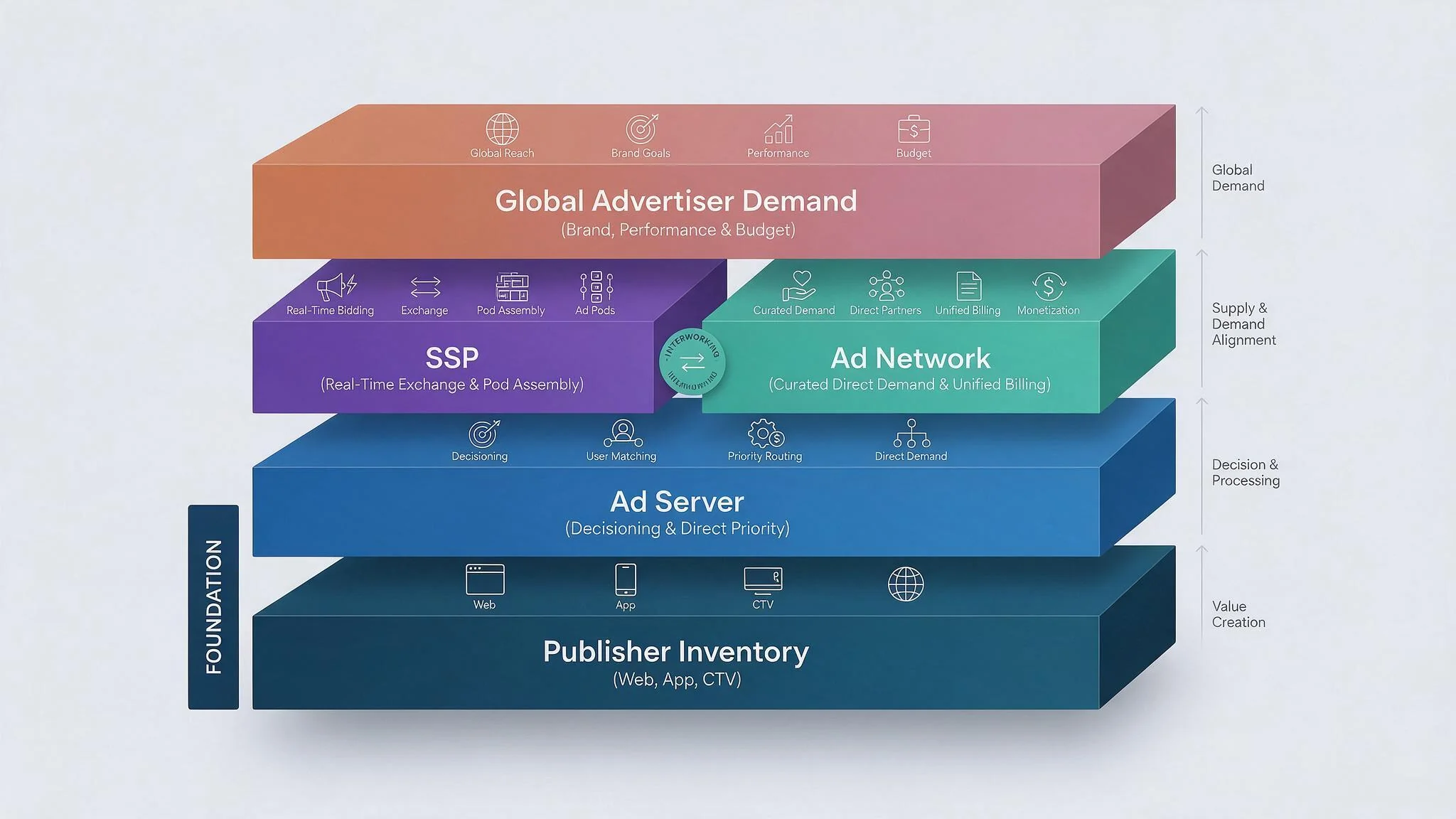
Three architectural shifts dismantled those strict boundaries over the past decade: the universal adoption of client-side and server-side header bidding via Prebid.org, the transition of primary ad servers from sequential waterfalls to unified first-price auctions, and the buy-side enforcement of Supply Path Optimization (SPO). Once Prebid.js, Prebid Server, and Prebid Mobile enabled multiple demand sources to bid simultaneously before the primary ad server was ever invoked, SSPs absorbed the underlying exchange infrastructure directly into their core stack. Today, an standalone "ad exchange" rarely exists outside of a broader SSP or primary platform ecosystem, such as Google AdX operating natively within Google Ad Manager (GAM).
Simultaneously, the functional gap between SSPs and ad networks narrowed from both directions. To defend take rates against aggressive DSP SPO initiatives, SSPs began building in-house agency sales teams, packaging publisher inventory into curated Private Marketplace (PMP) deals, and offering audience-enriched deal IDs, effectively assuming the demand-packaging role historically owned by ad networks. Conversely, sophisticated ad networks discarded legacy waterfall redirects and engineered proprietary OpenRTB 2.6 endpoints, custom Prebid adapters, server-to-server connections, and Google Multiple Customer Management (MCM) integrations.
For publisher engineering teams evaluating what an SSP is relative to a modern ad network or primary ad server, the distinction is no longer defined by whether a partner uses real-time bidding. Nearly every participant transacts via RTB protocols. Instead, the distinction lies in where the platform sits in the decisioning chain, who owns the direct contractual relationship with the advertiser or DSP seat, and who carries the operational burden of yield management and financial reconciliation.
Core Responsibilities of the Primary Ad Server (Decisioning, Direct Trafficking, and Forecasting)
Regardless of how many SSPs or ad networks compete in a publisher's header bidding wrapper, the primary ad server remains the ultimate gatekeeper and single source of truth for ad delivery. For the vast majority of institutional Web, Mobile App, and CTV publishers, Google Ad Manager (GAM or GAM 360) serves this role, alongside specialized SDK controllers in mobile and SSAI-integrated decisioning engines in streaming television.
The primary ad server executes four irreplaceable core functions that neither an SSP nor an ad network can replicate externally:
- Inventory Hierarchy and Slot Definition: The ad server defines the taxonomy of the publisher's supply through hierarchical ad units, fluid or fixed creative size maps, CTV ad pod structures, and custom key-value targeting parameters (such as page category, article sentiment, or authenticated first-party cohort segments).
- Direct Campaign Trafficking and Pacing: When an internal sales team closes a direct Insertion Order (IO) with an advertiser, those line items are trafficked inside the primary ad server. The ad server enforces priority tiers, managing time-based Sponsorship line items (GAM Priority 4) and volume-based Standard guaranteed line items (GAM Priorities 6 through 10). Its internal pacing algorithm calculates real-time delivery curves (Evenly, As Fast As Possible, or Frontloaded) while enforcing cross-session frequency caps, competitive exclusions, and roadblocks.
- Capacity Forecasting and Contention Simulation: Because the primary ad server observes 100% of ad requests across the property, it maintains a historical time-series model of impression volume. Before an AdOps team commits to a guaranteed direct IO or a Programmatic Guaranteed (PG) deal, the ad server's forecasting engine simulates the proposed line item against all active and scheduled contenders to compute exact available capacity and prevent under-delivery penalties.
- Holistic Final Auction Arbitration: When no guaranteed line item claims the impression, or when dynamic allocation permits programmatic demand to challenge guaranteed pacing at an opportunity-cost threshold, the ad server executes the final clearing auction. In GAM's Unified First-Price Auction, Priority 12 Price Priority line items (representing header bidding bids passed via Prebid key-values), Open Bidding (formerly EBDA) server-to-server partners, Remnant Network/Bulk line items, and Google AdX compete simultaneously on a net-CPM basis.
To illustrate how the primary ad server arbitrates external programmatic demand alongside internal direct campaigns, examine how a client-side Prebid.js 11.x implementation serializes winning SSP and network bids into GPT slot-level targeting keys before triggering the ad server request:
// Production Prebid.js 11.x to Google Publisher Tag (GPT) Arbitration Flow
window.pbjs = window.pbjs || { que: [] };
window.googletag = window.googletag || { cmd: [] };

const PREBID_TIMEOUT = 1200;

pbjs.que.push(function() {
  pbjs.setConfig({
    useBidCache: true,
    enableTIDs: true,
    priceGranularity: {
      buckets: [
        { precision: 2, min: 0.01, max: 5.00, increment: 0.01 },
        { precision: 2, min: 5.00, max: 20.00, increment: 0.05 },
        { precision: 2, min: 20.00, max: 50.00, increment: 0.50 }
      ]
    },
    ortb2: {
      site: {
        cat: ["IAB19", "IAB19-18"],
        content: { language: "en" }
      }
    }
  });

  pbjs.requestBids({
    timeout: PREBID_TIMEOUT,
    bidsBackHandler: function() {
      googletag.cmd.push(function() {
        // Injects hb_pb, hb_adid, hb_bidder, and hb_format into GAM slot targeting
        pbjs.setTargetingForGPTAsync();
        // Triggers GAM Unified Auction to arbitrate Prebid vs. AdX vs. Direct IOs
        googletag.pubads().refresh();
      });
    }
  });
});
In mobile application environments, this primary decisioning architecture is frequently paired with or executed through an in-app mediation layer using the GMA Next-Gen SDK or Prebid Mobile. In CTV, the ad server collaborates with an SSAI stitcher and the Google Interactive Media Ads (IMA) or Programmatic Access Library (PAL) SDK to construct multi-slot VAST 4.3 pods, ensuring that a single advertiser's creative is not duplicated within the same commercial break.
What a Modern SSP Provides Beyond OpenRTB Plumbing
While the primary ad server governs internal inventory allocation, it cannot natively broadcast bid requests to dozens of external DSPs without a specialized exchange fabric. That is the domain of the Supply-Side Platform. At the protocol level, an SSP ingests ad opportunities via Prebid.js client adapters, Prebid Server (Go or Java) S2S adapters, Prebid Mobile SDK hooks, or direct VAST/OpenRTB endpoints, and translates them into standardized OpenRTB 2.6 JSON payloads dispatched to buying platforms.
However, viewing an SSP merely as an OpenRTB pipe overlooks the heavy infrastructure required to make publisher inventory auction-ready and brand-safe at scale:
- Edge QPS Throttling and Smart Filtering: Tier-1 DSPs strictly enforce Queries Per Second (QPS) limits and penalize supply sources that flood their endpoints with low-value or unmonetizable traffic. A production SSP applies machine-learning traffic shaping at the edge, matching user geo, device type, viewability probability, and identity signals against historical DSP buying patterns so each buyer receives only the bid requests it is statistically likely to bid on.
- Pre-Bid Invalid Traffic (IVT) Mitigation: Before an impression ever enters an auction, a rigorous SSP validates device telemetry, IP reputation, user-agent integrity, and app-ads.txt / ads.txt authorization chains. At Sky Boosts, our SSP infrastructure enforces continuous pre-bid and post-bid filtration powered by HUMAN and Pixalate telemetry, alongside a strict 100% Google-friendly content and demand policy that blocks alcohol, gambling, adult, tobacco, and restricted categories at the exchange boundary.
- Protocol Normalization for Video and CTV: In CTV and instream video, SSPs handle the heavy lifting of VAST 4.3 parsing, creative wrapper unwrapping, mezzanine file inspection, and transcoding validation. This prevents malformed VAST XML payloads or unsupported video bitrates from reaching smart TV runtimes (such as Roku RAF, Apple tvOS, Samsung Tizen, or LG webOS) and triggering VAST 400-level media file errors.
Demand Curation, Auction Mechanics, and Yield Analytics
Beyond protocol translation and traffic hygiene, a modern SSP generates incremental yield through advanced auction mechanics and supply curation. Since the industry-wide transition to first-price auctions, DSPs deploy aggressive bid shading algorithms that attempt to predict the lowest price required to win an impression. If an SSP passes inventory to DSPs with static or zero floors, bid shading algorithms rapidly compress clearing prices toward the bottom of the bid landscape.
To counter bid shading, a high-performance unified monetization platform calculates dynamic floor elasticity in real time, adjusting the bidfloor attribute in the OpenRTB 2.6 request based on granular dimensions including device OS, hour of day, ad unit viewability tier, and competitive bid density. Furthermore, SSPs curate supply by packaging publisher first-party data (formatted as IAB Seller-Defined Audiences), high-viewability placements, or contextual signals into Deal IDs transmitted within the OpenRTB imp.pmp object.
Below is an example of an enriched OpenRTB 2.6 bid request generated by an SSP for a CTV ad pod opportunity, illustrating a clean single-hop schain object, dynamic floor signaling, and curated PMP deal packaging:
{
  "id": "80ce30c53c16e0b309f11234",
  "imp": [
    {
      "id": "1",
      "video": {
        "mimes": ["video/mp4", "application/x-mpegURL"],
        "minduration": 15,
        "maxduration": 30,
        "protocols": [7, 8, 11, 12],
        "w": 1920,
        "h": 1080,
        "startdelay": 0,
        "placement": 1,
        "linearity": 1,
        "podid": "pod_midroll_2",
        "poddur": 90,
        "maxseq": 3,
        "slotinpod": 1,
        "mincpmpersec": 0.65
      },
      "bidfloor": 14.50,
      "bidfloorcur": "USD",
      "secure": 1,
      "pmp": {
        "private_auction": 0,
        "deals": [
          {
            "id": "SB-CTV-PREM-2026",
            "bidfloor": 18.00,
            "bidfloorcur": "USD",
            "at": 1
          }
        ]
      }
    }
  ],
  "app": {
    "id": "ctv_app_9941",
    "name": "StreamLine Sports TV",
    "bundle": "com.streamlinesports.ctv",
    "cat": ["IAB17"],
    "publisher": {
      "id": "pub_4410"
    }
  },
  "device": {
    "ua": "Roku/DVP-12.5 (12.5.0.4178-91)",
    "ip": "198.51.100.42",
    "devicetype": 3,
    "make": "Roku",
    "os": "Roku"
  },
  "source": {
    "fd": 1,
    "tid": "f92a1109-4e1a-4b99-8d2c-110293847561",
    "ext": {
      "schain": {
        "complete": 1,
        "ver": "1.0",
        "nodes": [
          {
            "asi": "skyboosts.com",
            "sid": "pub_4410",
            "hp": 1
          }
        ]
      }
    }
  },
  "bcat": ["IAB25", "IAB26", "IAB9-9", "IAB8-5", "IAB8-18"],
  "tmax": 350
}
Notice the explicit bcat array blocking non-mainstream and restricted IAB categories (such as adult, illegal content, gambling, and alcohol) at the protocol level, alongside hp: 1 inside the single-node schain array. By maintaining a direct, single-hop ads.txt and sellers.json supply path, the SSP ensures that DSP SPO algorithms do not penalize or throttle the publisher's inventory during auction evaluation.
Why Value-Add Ad Networks Still Outperform Raw Exchanges for Mid-Market Apps and Sites
A frequent architectural misconception among growing publishers is assuming that cutting out ad networks and integrating ten raw SSP adapters directly into their client-side wrapper is the optimal path to higher eCPMs. While massive enterprise media conglomerates with twenty-person programmatic engineering and direct-sales organizations can manage dozens of direct SSP seats, mid-market and upper-mid-market publishers across Web, Mobile App, and CTV frequently experience severe yield degradation when relying solely on raw exchange connections.
First, raw SSPs and tier-1 DSPs operate on volume-driven attention economies. A single publisher generating 20 million to 150 million monthly impressions rarely possesses enough standalone scale to capture the attention of agency trading desks or trigger favorable QPS allocation from DSP algorithms. Without sufficient bid density, raw exchange connections expose the publisher's inventory to sparse one-bidder auctions where DSP bid shading reduces clearing prices to the bare minimum floor.
Second, accessing Google's primary demand ecosystem (Google AdX and Open Bidding) directly requires qualifying for and maintaining a direct GAM 360 enterprise contract with substantial monthly impression minimums. Value-add ad networks that operate as certified Google MCM partners (via Both Manage Inventory and Manage Account frameworks) bridge this structural gap. Through comprehensive publisher solutions, a hybrid ad network and SSP platform aggregates clean, thematic inventory across hundreds of vetted properties, creating an institutional-grade supply pool that commands tier-1 DSP prioritization and direct AdX access without forcing the publisher to clear enterprise volume hurdles independently.
Bundled Direct/Semi-Direct Demand, Managed AdOps, and Consolidated Net-30/60 Payouts
When a modern ad network is built natively atop an SSP and primary ad server stack, as Sky Boosts is engineered, it delivers three tangible operational and financial advantages that raw exchange pipes do not provide:
- Bundled Direct, Semi-Direct, and Curated Demand: Rather than leaving a publisher's inventory solely at the mercy of the open exchange, a value-add ad network brings pre-negotiated agency PMPs, house-curated vertical packages, and direct advertiser budgets that automatically map to eligible publisher placements. Because these deals clear at pre-negotiated fixed or high-floor CPMs (as shown in the
SB-CTV-PREM-2026deal node in the OpenRTB snippet above), they establish a high-water price anchor in the unified auction, forcing open-market DSPs to bid higher to compete. - Managed AdOps and Continuous Wrapper Engineering: Maintaining a competitive programmatic stack is not a set-and-forget deployment. Prebid.js 11.x requires continuous module updates, user ID submodule tuning, timeout curve optimization across desktop and mobile connection speeds, and lazy-loading intersection observer tuning to protect Core Web Vitals (specifically Interaction to Next Paint and Cumulative Layout Shift). In CTV and mobile apps, engineering teams must constantly troubleshoot VAST 4.3 error codes, update GMA Next-Gen SDK adapters, and calibrate dynamic floors against seasonal Q1-to-Q4 demand swings. A value-add ad network provides dedicated AdOps architects who actively manage floor elasticity, wrapper depth, and GAM line-item configuration on the publisher's behalf.
- Consolidated Net-30 and Net-60 Working Capital Cycles: Managing direct contracts with twelve independent SSPs creates a fragmented accounting burden. Many standalone exchanges enforce high minimum payout thresholds, impose sequential liability clauses that delay payment until the end advertiser pays the agency (often stretching cash conversion cycles to 90 or 120 days), and apply unpredictable post-auction clawbacks if upstream traffic validation fails. By contrast, partnering with a unified ad network and SSP that enforces strict pre-bid HUMAN and Pixalate IVT filtration and 100% brand-safe demand consolidates all programmatic streams into a single, predictable Net-30 or Net-60 payout schedule.
To architect a resilient monetization stack, publisher engineering and revenue leaders should apply a clear division of labor across their infrastructure. Use the primary ad server (GAM) strictly as your central decisioning authority and direct-sales ledger. Leverage an SSP architecture that enforces single-hop schain transparency, OpenRTB 2.6 standards, and edge IVT filtration. Finally, anchor your programmatic wrapper with a unified ad network and MCM partner that bundles curated demand, actively tunes your auction floor mechanics, and converts fragmented programmatic clearing events into reliable Net-30 or Net-60 cash flow.